


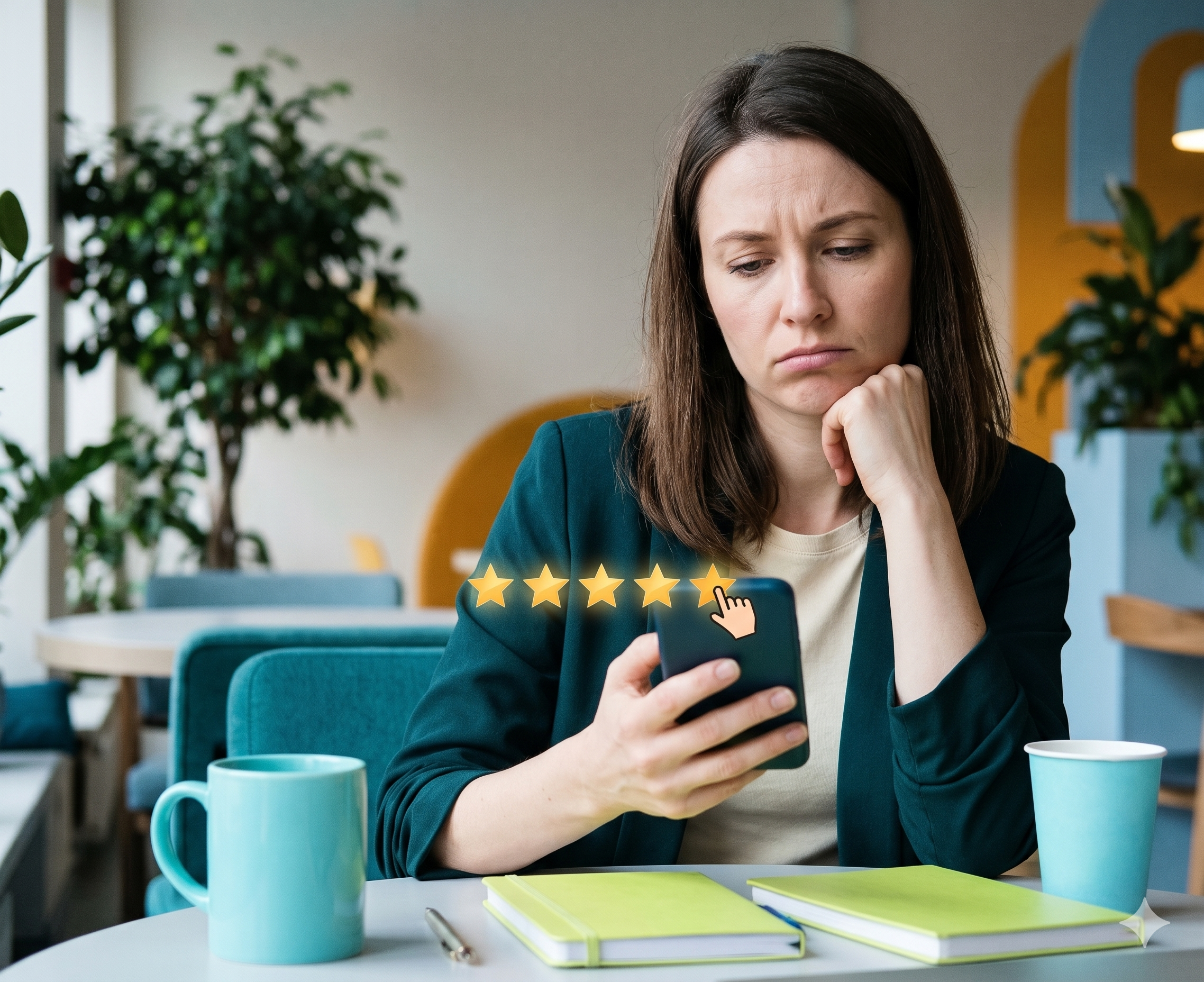
I have a marketplace I keep coming back to. I know how it works, trust the experience, and rarely think twice before placing an order. But every now and then, a notification from a competing marketplace catches my attention. A better price, a tempting offer, or a product I have been looking for is enough to make me open another app and compare.
I have not stopped shopping with my preferred marketplace. But for a moment, my loyalty is up for reconsideration.
That small shift says something important about how customers behave today. Familiarity and convenience still matter, but they do not necessarily rule out other options. Research published in Information Systems Research found that mobile push notifications increased coupon redemption by 6% in a retail field experiment, showing how easily a well-timed offer can bring an alternative into a customer’s consideration.
For businesses, this creates a problem that repeat purchases and retention rates alone cannot fully capture. Customers can keep buying without feeling committed. They may be satisfied enough to stay, but not convinced enough to stop looking.


The Q3 2026 Sogolytics CX Index offers evidence of this distinction. The strongest tier of customer loyalty is shrinking, even as many customers continue to describe themselves as loyal. Their relationship with a brand is not necessarily broken, but it may be less secure than their behavior suggests.
This is conditional loyalty: customers stay as long as the experience gives them a reason to. For CX leaders, the challenge is no longer just to get customers to return. It is to give them fewer reasons to reconsider.
Staying is No Longer Proof of Loyalty
The Q3 data shows the gap between staying and feeling loyal in plain numbers. The share of customers who call themselves “very loyal” dropped to 29% this quarter, down from 35% in Q2 and the lowest reading of the year. Most of those people did not turn disloyal. They slid into “somewhat loyal,” which rose to 41%. The total loyal group held steady while the strongest tier thinned out. Fewer people are willing to say they are all in.
Then there is the finding that catches most leaders off guard. When you ask who is very likely to switch after one bad experience, self-described loyal customers come out highest at 13%, ahead of disloyal customers at 9%. Neutral customers are the safest group of all, with only 21% saying they are somewhat or very likely to switch. The loyalty label tells you how someone feels about your brand today, but does not tell you whether they will stay tomorrow.
It’s this uncertainty that makes conditional loyalty difficult to spot. Customers may continue logging in, renewing subscriptions, and collecting rewards, so the usual measures suggest that the relationship is healthy. Yet their willingness to stay may be weakening as they become more open to alternatives, especially when another brand offers a better experience.
Four Types of Loyalty That Look Identical on a Dashboard
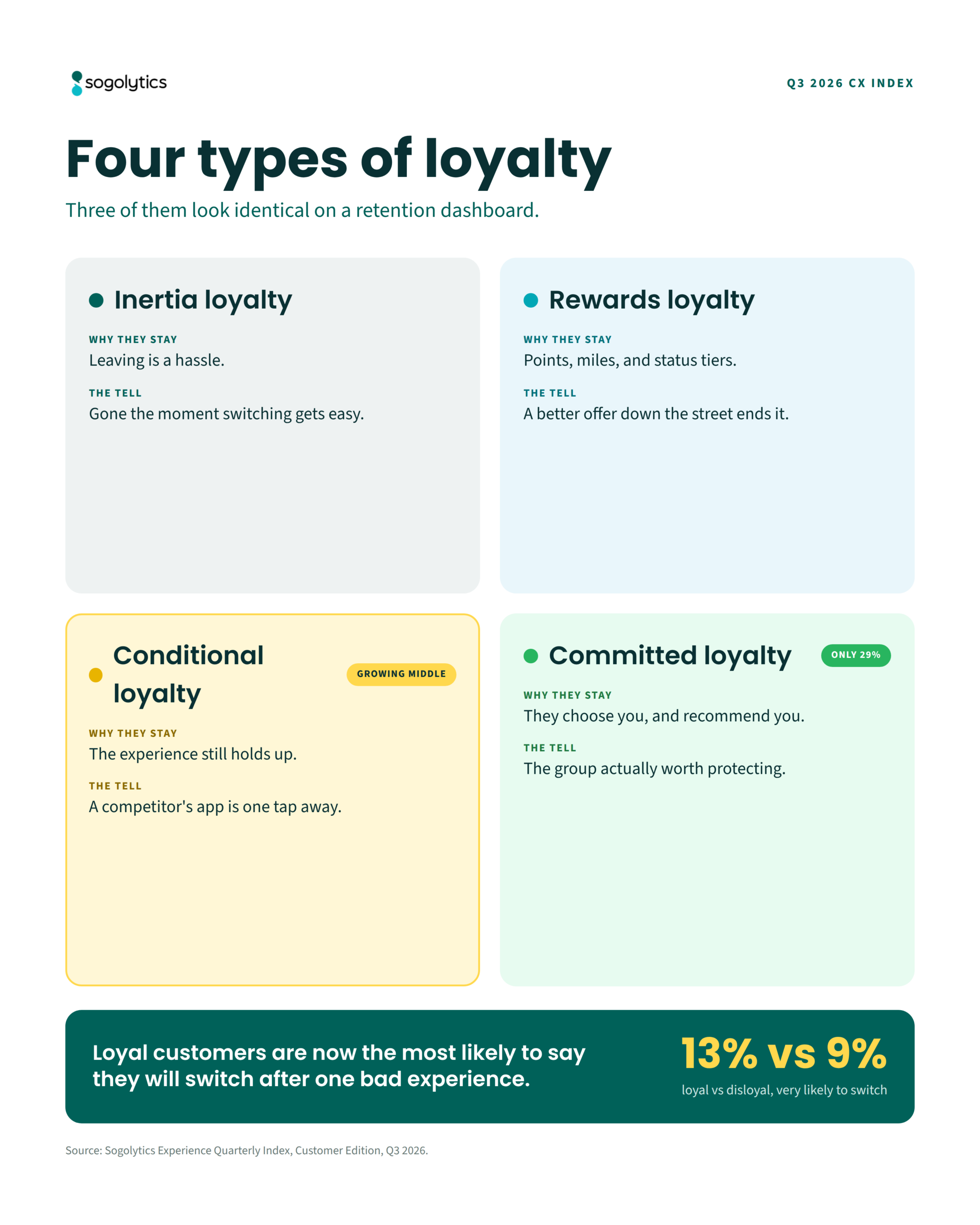
Customers may keep buying from a brand for very different reasons. Some genuinely prefer it, while others stay because switching feels like too much effort or because they want to keep their rewards. These customers may look equally loyal in a retention report, but their willingness to stay can be very different. To understand what their behavior really tells us, let’s look at the four types of customer loyalty and what each means for businesses.
1. Inertia loyalty
The customer stays because leaving is a hassle. Think of an internet provider where switching means equipment returns, install windows, and a new contract. The person is not committed, just stuck, and they will move the moment the friction drops.
2. Rewards loyalty
The customer stays for points, miles, or a status tier. This looks like devotion, but it is a trade, and a better offer down the street can end it. In the Q3 data, affordability (22%) and product quality (21%) top the list of what drives long-term loyalty, while personalized perks come last at 6%, down from 9% the quarter before.
3. Conditional loyalty
The customer stays as long as the experience holds up. This is the large and growing middle. They buy from you, recommend you sometimes, and keep a competitor’s app one tap away. Every interaction is a small renewal of the relationship or a small withdrawal from it.
4. Committed loyalty
The customer stays by choice and would defend you to a friend. This is the group worth protecting, and it is smaller than most brands assume. The Q3 “very loyal” tier sits at just 29%.
Although these types of loyalty can look similar in a report, what drives customers to stay or reconsider their options varies by industry. Price and convenience may influence a retail shopper, while trust, service reliability, or the ease of switching may matter more across industries like banking, healthcare, or telecommunications.
How Conditional Loyalty Plays Out Across Industries
Conditional loyalty cuts across industries, but the factors that influence whether customers stay or look elsewhere vary with the nature of the relationship, the cost of switching, and what customers expect from each experience.
Retail offers a clear example of how conditional loyalty works in practice, as shoppers may continue visiting a familiar store while comparing prices and offers from competitors before making a purchase. Although retail moved up from fifth to fourth place in the Q3 rankings, that improvement does not necessarily mean customers are becoming more committed to the brands they shop with, particularly when a better price or a more convenient option can influence their next purchase.
Financial services, ranked second in the Q3 Index, show why customer loyalty can be difficult to read. For instance, account holders may stay with a bank for years because their accounts, payments, and financial commitments are already in place, even when their experience begins to disappoint them. That makes it easy for businesses to mistake continued account activity for genuine loyalty. Customers who quietly disengage deserve as much attention as those who complain, because their decision to leave may already be taking shape before the business notices a problem.
In healthcare, ranked third, loyalty depends heavily on trust and the way patients are treated throughout their care. The Q3 Index found that preference for a human over AI in healthcare increased from 44% among people aged 28 to 44 to 71% among those aged 60 and older. For providers, this is a reminder that convenience through automation does not always translate into a better patient experience. When people need reassurance or personal attention, an interaction that feels impersonal can undermine their confidence even if the medical care itself meets expectations.
Travel and hospitality face a similar need to meet expectations consistently, since guests often judge an entire stay by a few important interactions, from check-in to how staff handle a problem. Telecommunications, which ranked last in the Q3 Index, illustrates the other side of the issue. Customers may remain with a provider because switching is inconvenient, not because they are happy with the service. If a competitor offers a compelling reason to move, that inertia may no longer be enough to keep them.
These examples show why customer loyalty cannot be understood through retention figures alone. A bank customer may stay out of convenience, a patient may reconsider a provider after an impersonal interaction, and a hotel guest may not return after one disappointing stay. In each case, the relationship depends on whether the experience continues to meet expectations, not simply on how long the customer has been around.
Why One Good Quarter Does Not Fix It
The Q3 Index tracks two satisfaction scores at once, and they moved in opposite directions this quarter. Satisfaction with the most recent experience jumped four points to 73%. Overall satisfaction with the brand slipped to 62%. The gap between them is now 11 points. One number moves fast because it reflects a single good moment. The other moves slowly because it reflects a reputation built over time. A strong week does not reset how a customer feels about you in general.

So a reliable experience matters more than a spectacular one. A single standout moment feels good and then fades. An experience the customer can count on, week after week, is what turns staying into commitment. The data makes the link concrete: among customers who saw clear improvement after giving feedback, 53% describe themselves as very loyal, compared with only 30% of those who saw no change.
There is a warning sign in the same report. The share of people who said their feedback led to clear improvement fell from 42% to 30% this quarter, while the share who saw no change nearly doubled, from 17% to 29%. Customers are speaking up and watching nothing happen. For a conditionally loyal customer, that silence is a reason to start looking.
Five Ways To Build The Consistency That Keeps Conditional Customers
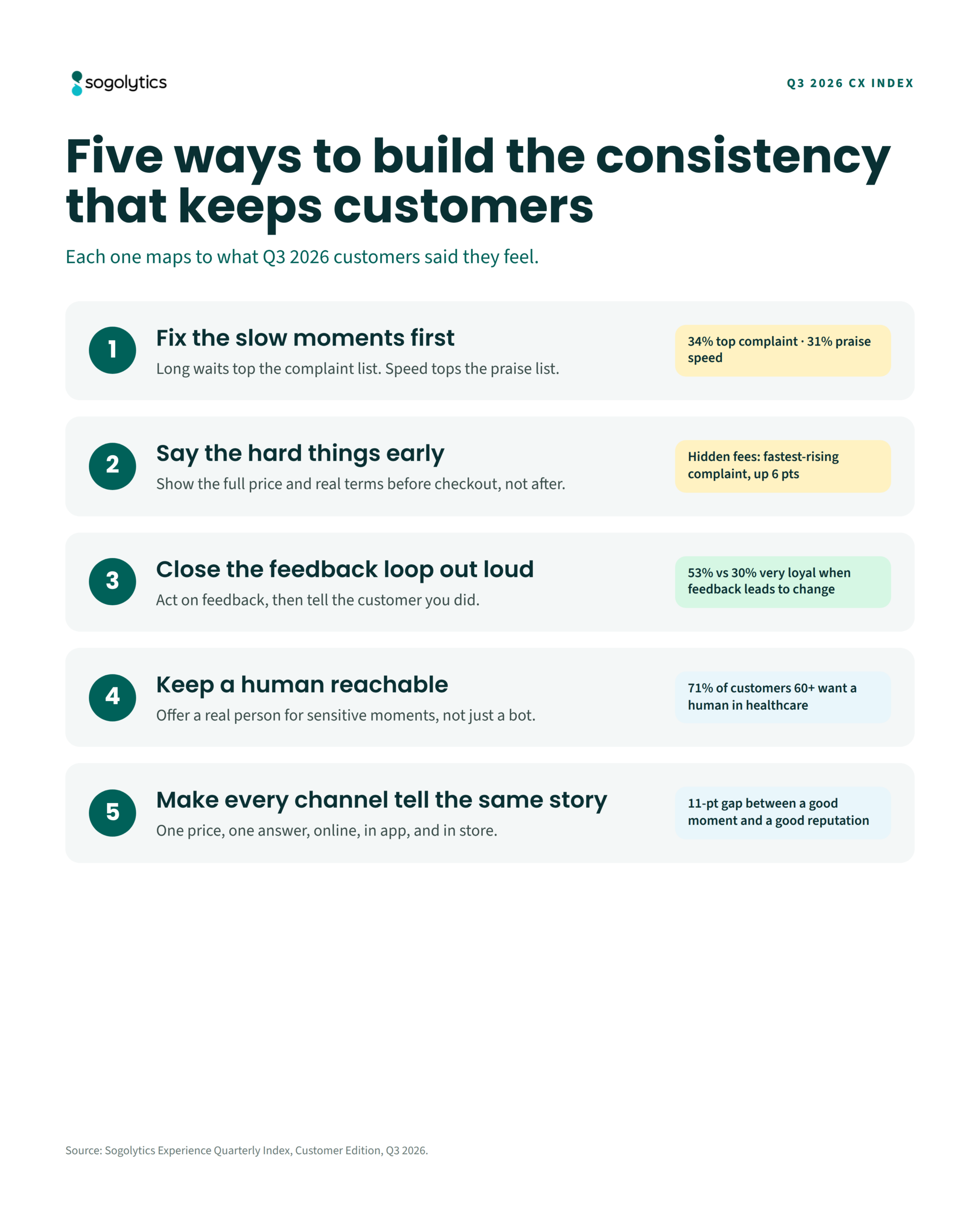
The reasons customers stay may differ across industries, but the expectation for a reliable experience remains much the same. Customers want businesses to deliver on their promises, respond when something goes wrong, and make it easy to get the help they need. The Q3 data points to a few areas where companies can make a meaningful difference, from responding faster and being upfront about costs to acting on feedback and making support more accessible. Here are five practical ways CX teams can turn those expectations into more consistent experiences.
2. Fix the slow moments first
Long wait times tied for the top driver of bad experiences at 34%, and fast response leads the good ones at 31%. A retailer that promises a callback window and keeps it removes the single most common reason customers go looking elsewhere.
2. Say the hard things early
Hidden fees and misleading information were the fastest-rising complaint in Q3, up six points. Tell customers the full price and the real terms before checkout, not after. A credit union that shows every fee on the account-opening screen earns more trust than one that explains them later.
3. Close the feedback loop out loud
Customers who see action after feedback are far more likely to stay very loyal. When you make a change because someone asked, tell them. A hotel that emails a guest to say “you flagged slow check-in, and here is what we changed” turns one complaint into a reason to return.
4. Keep a human reachable where it counts
In sensitive moments, people still want a person, and that is sharpest in healthcare and in money conversations. Let customers reach a human without a maze of menus, and save automation for the simple, fast tasks where it genuinely helps.
5. Make every channel tell the same story
A customer who hears one price on the phone, sees another online, and gets a third answer in the store learns that you cannot be trusted to stay consistent. Line up what the website, the app, the call center, and the front desk all say.
None of these needs new technology or a bigger team. They need the same promise kept across every touchpoint, every time.
Finding the Friction You Cannot See
One of the challenges with conditional loyalty is that customers do not always tell a company when their experience starts falling short. They may continue doing business with a brand even as their confidence in it weakens, making it difficult to recognize the problem before it affects retention. Looking at churn figures alone may offer little insight into where that shift began or what prompted customers to reconsider their relationship with the company.
CX teams need a closer look at the customer journey to understand where expectations are not being met and which gaps deserve attention. Sogolytics’ Experience Navigator is built to help organizations examine these areas based on their industry, business model, operational setup, and goals. It uses that context to help teams identify potential gaps across their customer journey and determine where improvements may have the greatest impact. This gives teams a more focused starting point for addressing the issues that can weaken customer loyalty, rather than relying on overall satisfaction scores to tell the whole story.
What CX leaders can expect in 2027
Customer loyalty is becoming harder to sustain, not necessarily because customers are less willing to commit, but because they have more reasons to reconsider their choices. The Q3 2026 CX Index shows why businesses need to look beyond retention figures and pay closer attention to what customers value, where experiences fall short, and what makes them choose to stay.
As CX leaders plan for 2027, the priorities are becoming clearer. Customers want fair prices and confidence that their data is protected. They expect technology, including AI, to make their lives easier rather than add friction. And businesses need to understand how customer perceptions change over time, instead of assuming that renewals and repeat purchases signal a healthy relationship.
None of this requires companies to make every interaction extraordinary. It requires them to get the important things right consistently, from setting clear expectations to resolving problems and following through on their feedback. When customers know they can count on a brand to deliver, they have fewer reasons to look elsewhere.
The goal is not simply to keep customers but to give them a reason to keep choosing you.
Conditional loyalty is when a customer keeps buying from a brand but stays open to switching. They have not committed. They stay as long as the experience meets their expectations, and they start looking elsewhere when it slips.
Not always. Long tenure can mean real commitment, or it can mean the customer finds switching too much of a hassle. In the Q3 2026 CX Index, self-described loyal customers were actually the group most likely to say they would switch after one bad experience, at 13%.
Because the loyalty label describes how someone feels, not what they will do. A customer who feels strongly about a brand also expects more from it, so a single let-down can feel like a bigger betrayal than it would to a neutral customer.
Satisfaction is how a customer feels about one recent experience. Loyalty is how they feel about the brand overall and whether they will stay. The Q3 data showed recent-experience satisfaction at 73% but overall satisfaction at 62%, an 11-point gap, which shows the two do not move together.
By being consistent. Fix slow moments, be honest about pricing, act on feedback and say so, keep a human available for sensitive issues, and make sure every channel gives the same answer. Customers who saw clear improvement after feedback were far more likely to call themselves very loyal (53% versus 30%).
No. It shows up as price-checking in retail, as quiet drop-off in financial services, as a preference for human care in healthcare, and as inertia in telecom. The common thread is that the customer’s next choice depends most on their most recent experience.