
Compliance is often measured by what an institution discloses. Member experience is measured by how members respond. For credit unions, the gap between these two measures can reveal a risk that neither compliance audits nor member satisfaction scores capture on their own.
Consider a routine fee increase. A member opens a new account and leaves the branch with a folder containing every required disclosure, including a maintenance fee buried a few pages in. Months later, that fee appears on a statement and feels like a surprise. The credit union had disclosed it, but the member never understood it was coming. On a compliance report, that is a clean disclosure. In the member’s memory, it is a small breach of trust.
This distinction matters because trust is central to the credit union relationship. The Credit Union Member Experience Index and Benchmarks 2026 found that 80% of members agree their credit union is honest and transparent with them. But transparency is not simply about making information available. It also depends on whether members understand what they are being told, when they are being told it, and what it means for them.
A disclosure can satisfy every regulatory requirement and still leave a member confused. That confusion can lead to complaints, erode trust, and expose gaps in how an institution communicates its policies and obligations. For credit union leaders, this makes member experience data more than a measure of satisfaction. It can offer an early view into where compliance risks may be taking shape, often before they surface in a formal complaint or audit.


Compliance and Member Experience are the Same Conversation
Members hand over their money, their personal data, and their long-term plans to an institution they believe will look out for them. When that belief is shaken, even a little, the damage spreads past one account. Credit unions start with an edge here, because they are member-owned, community-rooted, and built to serve people rather than shareholders. That edge does not maintain itself.
The 2026 Index shows where the strain appears. The same members who rate their credit union highly on honesty are far less sure it listens to them. The lowest-scoring question in the entire trust dimension is whether the credit union listens to feedback and acts on it, at 71.6 out of 100. About 9% of members openly disagree that their credit union listens, and another 17% sit on the fence.
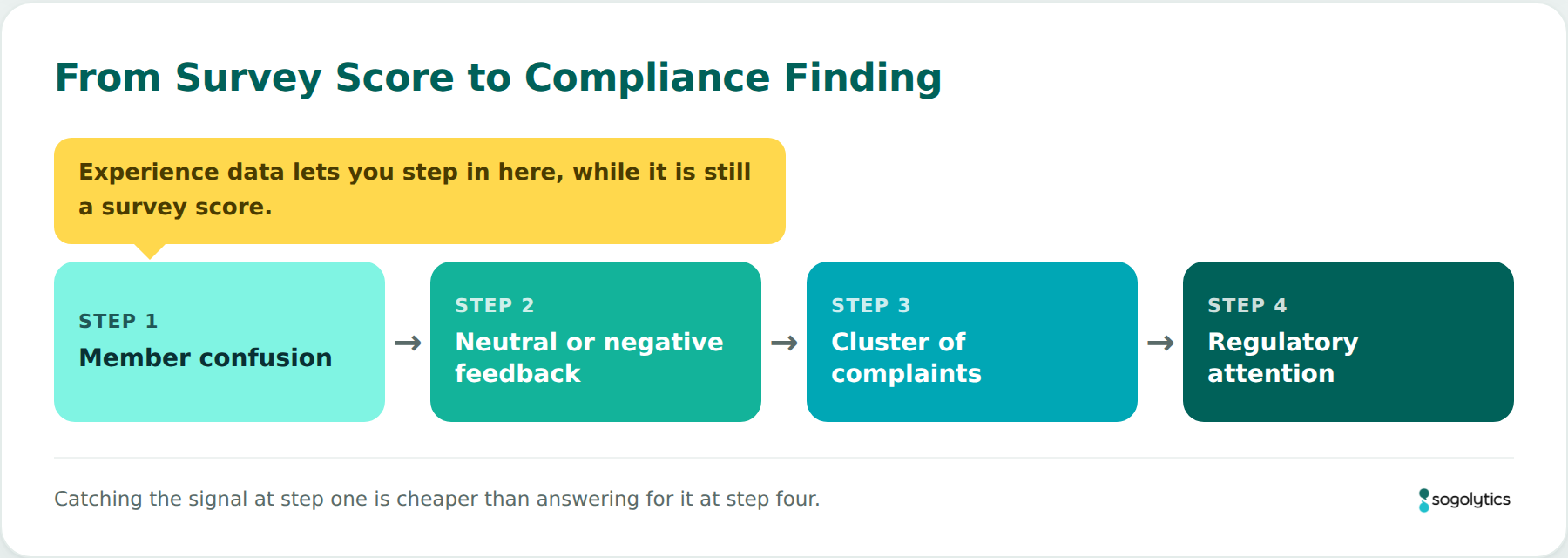
That split matters for compliance. A member can trust that you are honest and still feel that you are not really hearing them. When members feel unheard, small frustrations grow into formal complaints, and formal complaints are what regulators notice. Experience data gives you a way to catch that frustration while it is still just a survey score.
4 Types of Compliance Risk That Start as Experience Problems
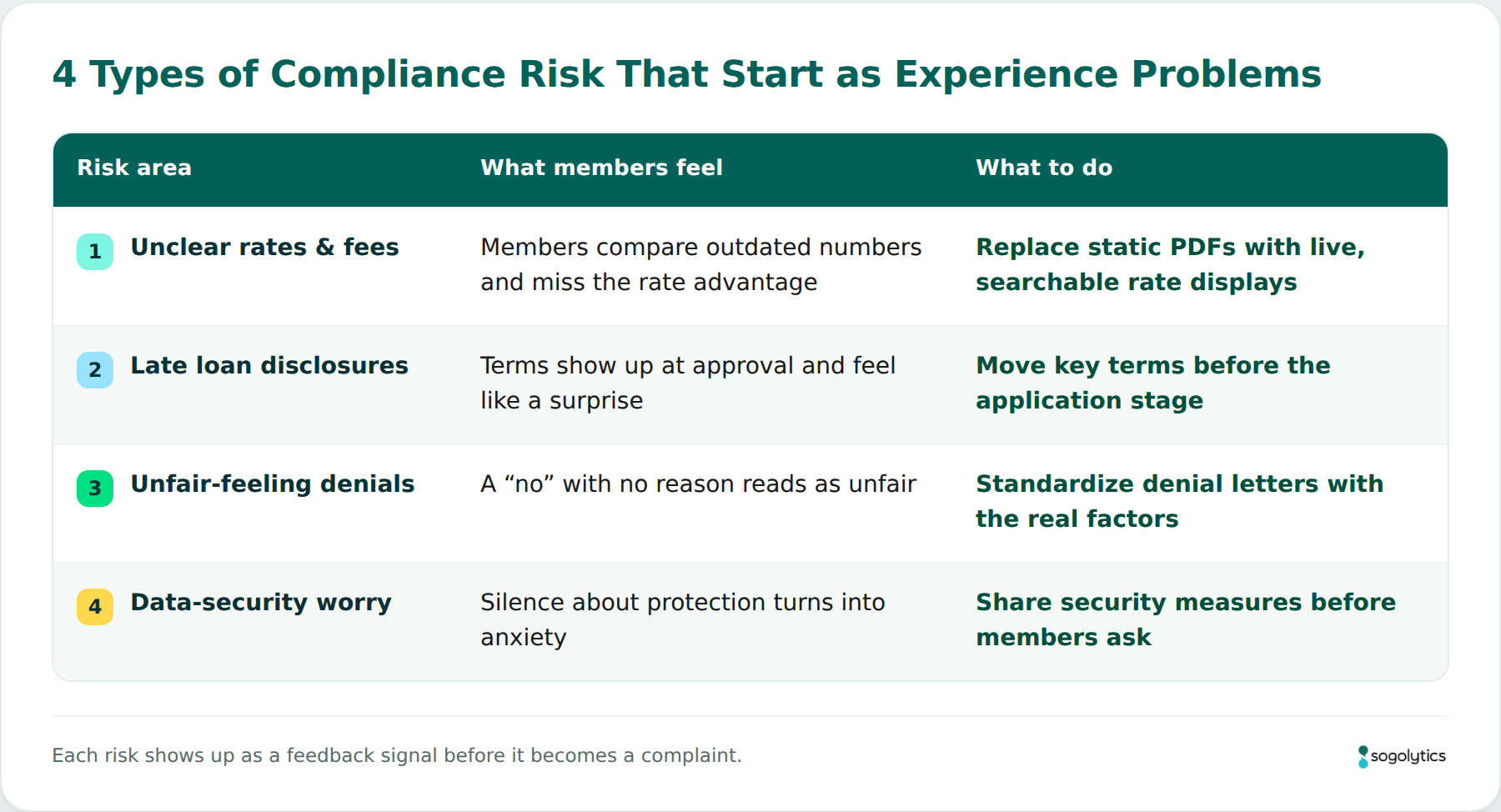
Most compliance problems start as ordinary moments that confuse or frustrate a member, long before they become legal events. Here are four of the most common, and how each one shows up in member feedback.
1. Unclear Rates and Fees
When rates and fees live in a static PDF or a dense printed packet, members cannot easily find or understand them. Someone comparing a loan might be looking at outdated numbers without knowing it. In the 2026 Index, satisfaction with rates scored 73.0, one of the five lowest scores in the whole survey, and 16% of members were neutral, meaning they do not clearly feel the rate advantage credit unions are supposed to offer. Low clarity on a rates page is both an experience gap and a disclosure risk.
2. Loan Terms Revealed Too Late
Imagine a member who applies for an auto loan, feels confident through the whole process, then reaches approval and learns the terms differ from what they expected. That surprise feels unfair, even when every term was technically correct. Disclosures that wait until the end of an application are a routine source of member dissatisfaction, and sometimes complaints to regulators. The experience signal is simple to spot: members who feel surprised at the approval stage.
3. Unfair-Feeling Lending Decisions
When a loan is denied without a clear reason, members are left guessing, and people who are left guessing tend to assume the worst. The decision may have been completely correct. The problem is that it did not feel fair. The same thing happens when two members in similar situations get different levels of clarity from different loan officers. That inconsistency creates a fairness gap that can grow into a complaint. Feedback that tracks how members feel about denial explanations tells you where this risk is forming.
4. Worry About Data and Security
Members care deeply about whether their money and personal information are safe. When they do not hear enough about how their credit union protects them, that silence can turn into anxiety, especially after a data breach makes the news somewhere else. Member feedback often picks up this worry before anything goes wrong, which gives you a chance to communicate ahead of time instead of reacting to fear.
5 Ways Credit Unions Can Use Experience Data to Lower Compliance Risk
Spotting the risks is the first half. Here is how to use what members tell you to actually reduce them.
1. Treat Member Feedback as an Early Warning System
Every complaint category is a clue. When you track the topics members raise, such as confusing fees, loan surprises, and denial explanations, you can see which ones line up with real regulatory exposure. This is where a tool like Experience Navigator helps. It groups member feedback by touchpoint and flags the complaint categories tied to compliance, so a rise in confusion about a fee change reaches the right team while it is still small. Remember, only 74% of members in the 2026 Index feel their credit union listens and acts on feedback. Closing that gap starts with actually watching the feedback.
2. Make Disclosures Clear, Not Just Available
A disclosure that nobody understands meets the rule but does not actually inform anyone. Plain language is the fix. Instead of a wall of legal text, a short explanation in everyday words tells the member what is changing and why. The payoff is real. In the 2026 Index, 80% of members said they were satisfied with how clearly their credit union communicates about accounts, rates, and important changes, and only 7% were dissatisfied. Keeping that clarity score high protects both the member relationship and your compliance position.
3. Share Key Loan Terms Before the Approval Stage
The simplest way to remove the approval-stage surprise is to move the important terms earlier. When members see the rate, the fees, and the main conditions up front, approval becomes a confirmation instead of a shock. Experience data helps you find where this breaks down. If feedback shows members are regularly surprised at approval, that is your sign to redesign the order of your disclosures, not to add another line to the fine print.
4. Standardize Your Hardest Member Conversations
Fee changes and loan denials are the moments most likely to damage trust, so they deserve the most care. A plain-language template for fee-change notices makes sure every member gets the same clear explanation. A standard format for denial letters, with the real factors spelled out, keeps the experience consistent from one loan officer to the next. Consistency here does two things at once. It lowers the chance of a fairness complaint, and it makes the member feel respected even when the answer is no.
5. Close the First-Year Trust Gap
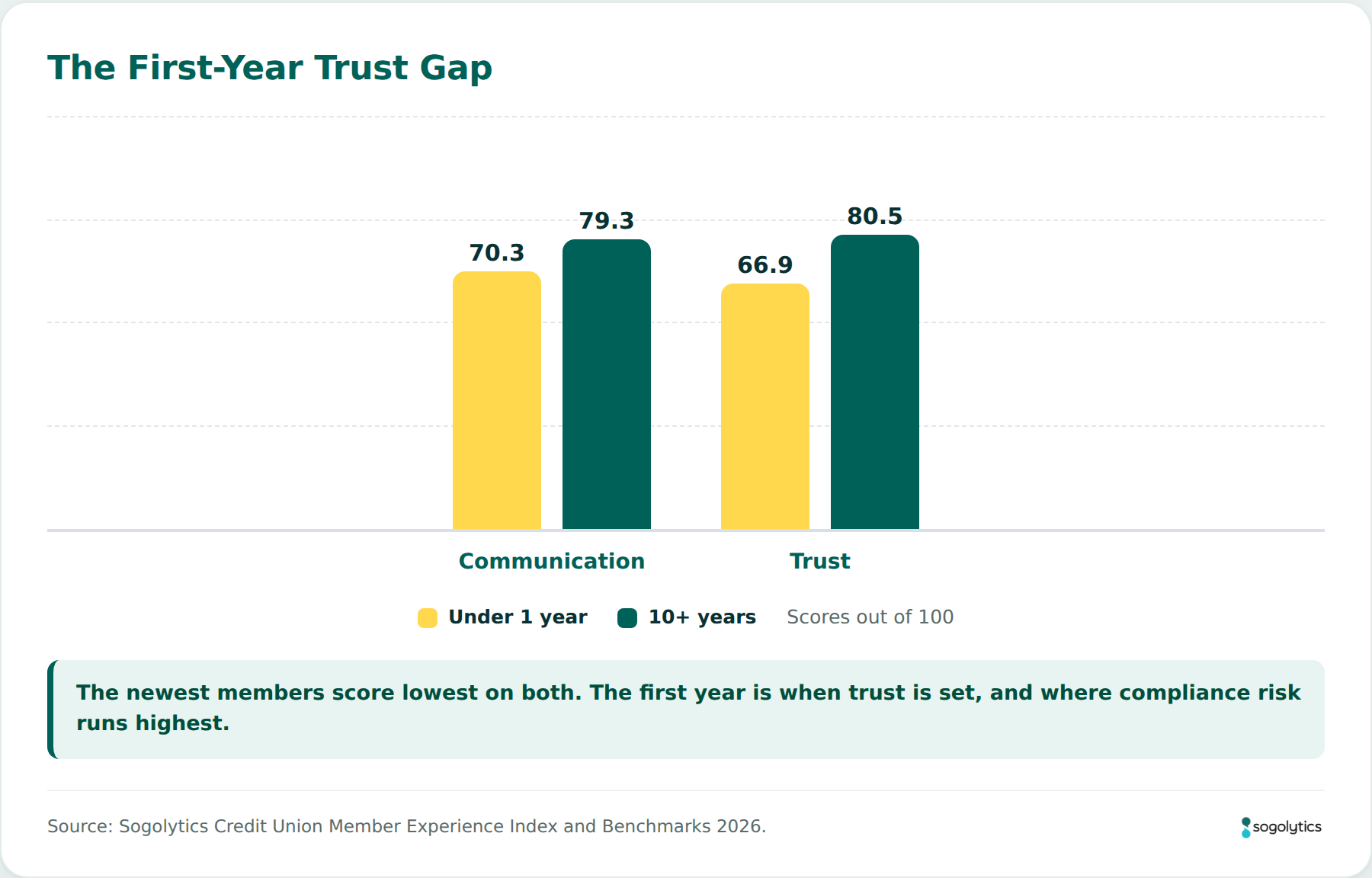
New members are the most at risk, and the numbers are striking. In the 2026 Index, members with less than a year of tenure rated how well their credit union communicates at 70.3, while members of ten years or more rated it at 79.3. Trust follows the same pattern, at 66.9 for the newest members versus 80.5 for the most tenured. The first year is when expectations are set and trust is either earned or lost. Clear onboarding, readable account documents, and a welcome that explains the important terms in plain words all lower the chance that a confused new member becomes an early complaint. Experience Navigator’s onboarding view is built around this stage, helping credit unions see where new members get lost.
What This Looks Like in Practice
Say a credit union notices that clarity scores on its rates and fees page have slipped over two quarters. On their own, those scores might look like a minor service issue. Looked at through a compliance lens, they are an early signal. The team digs in and finds that the online rate sheet is a PDF that has not been updated since the last rate change, so members have been comparing old numbers. They replace it with a live, searchable display, add a short plain-language note about the most recent change, and watch the clarity score recover.
Nothing about that story involved a regulator, and that is the point. The credit union fixed a disclosure problem while it was still a dip in a survey, long before it could become a complaint or a finding. The feedback did the early work, and acting on it kept a small issue small.
Conclusion
You do not need a new program to begin. Start with the places members already tell you they are confused: a drop in clarity scores on your rates page, a cluster of questions after a fee change, a rise in neutral answers when you ask whether you listen. Each of those is a service signal and a compliance signal at the same time. Catching them in a dashboard this quarter costs far less than explaining them to an examiner next quarter. When you treat member feedback as part of risk management, not just marketing, you give the whole organization the earliest possible warning and the most time to act.
Compliance risk is the chance that something your credit union does, or fails to explain, breaks a rule or triggers a regulator’s attention. Many of these risks start as experience problems. A fee a member does not understand or a loan term revealed too late can become a complaint, and complaints are often where compliance issues begin.
Member feedback shows you where people are confused or feel treated unfairly, usually long before it becomes a formal complaint. By tracking those signals, you can fix a confusing disclosure or an unclear fee while it is still small, rather than waiting for a regulator to find it.
The most common are unclear rates and fees, loan terms shared too late in the process, lending decisions that feel unfair, and a lack of clear communication about data security. Each one tends to appear in member feedback before it turns into anything official.
These are the moments members feel most strongly. A fee increase or a loan term that surprises someone at approval can feel like a broken promise, even when every detail was technically disclosed. That feeling is what drives members to complain, and sometimes to contact a regulator.
Experience Navigator organizes member feedback by touchpoint and flags complaint categories tied to regulatory exposure, such as fee confusion or unclear disclosures. That early visibility lets credit unions act on a problem while it is still a survey score, not a finding.
Make it an ongoing habit rather than a once-a-year check. Watching clarity and trust scores each quarter, and reviewing them right after any rate or fee change, gives you the earliest warning of where a disclosure might be causing confusion.