
When it comes to digital banking, features such as mobile check deposits, quick account opening, and responsive support are now standard customer expectations. Banks need to look beyond these capabilities to understand what keeps customers satisfied, where their experience falls short, and how those insights can inform everyday decisions.
Consider a bank with a well-reviewed mobile app, a quick account opening process, and a helpful call center. The latest Sogolytics Q3 CX Index Report ranks financial services second among nine industries for customer experience, behind entertainment and media. Despite these positive signs, the bank may still face rising complaints and stagnant cross-selling results, while its survey scores offer little explanation for the disconnect. Understanding why these outcomes coexist requires a closer look at what customers experience across their interactions with the bank.


For years, banks gained an advantage by introducing digital features that made transactions easier. However, capabilities such as mobile check deposits have become common across the industry, leaving less room for differentiation through technology alone. Banks now need to focus on how effectively they deliver on customer expectations and respond when something goes wrong.
Here’s where experience operations comes into play, as it treats customer experience as an ongoing operational responsibility rather than a set of scores reviewed periodically. Experience operations connect customer feedback with the teams responsible for addressing problems and help banks assess whether their changes are making a difference. This blog examines why the approach matters, the four changes it requires, and the role of clear ownership in making it work.
The Consistency Gap is the Real Problem
The clearest sign that measuring customer experience is not enough is the gap between satisfaction with an individual interaction and satisfaction with the brand overall. In the Q3 2026 Index, 73% of customers were satisfied with their most recent experience, up four percentage points in a single quarter. However, overall brand satisfaction stood at just 62%, an 11-point gap that suggests a positive interaction does not necessarily translate into a stronger perception of the brand. Banks and financial institutions face the same challenge: a smooth transaction or helpful service call may satisfy a customer in the moment, but sustained satisfaction depends on the experience the bank delivers over time.
A survey can show you that gap, but it cannot close it on its own. Any one team can deliver a single good moment. What is hard is stringing those moments into a relationship that feels consistent, because that depends on how dozens of teams coordinate, each owning a different piece of the journey. That makes it an operations problem, not a measurement problem.
Think about what the gap feels like for a customer. The app works beautifully on Monday. On Thursday a payment fails, the chatbot loops, and the branch has no record of the earlier call. Each team did its job. The customer still walked away feeling the bank does not have its act together.
One Relationship, a Dozen Owners
A customer’s relationship with a bank rarely stays within one channel. They might start a loan application on the mobile app, check details on the website, receive an email from the lending team, and call customer support for clarification. Although these interactions are part of the same customer journey, different teams often manage them using separate systems, processes, and performance goals.
This creates a gap between how customers experience the bank and how the bank is organized to serve them. Each team may meet its own targets, yet the overall experience can still feel inconsistent. Collecting more feedback will not resolve the problem if teams lack the ownership or coordination needed to address issues that cross departmental boundaries.
For example, a customer might start a loan application in the app, receive a follow-up email with different figures, and then have to explain the discrepancy to a support representative. Each interaction adds friction because the teams involved are not working from the same information. A post-interaction survey might capture the customer’s frustration, but resolving it requires the bank to examine how information moves between teams and where the handoff breaks down.
From Touchpoints to an Operating Model
Banks need to map the full customer journey, including digital channels, branches, ATMs, behind-the-scenes processes such as identity verification, and interactions with employees. Our guide to customer journey mapping explains how to identify potential friction across these interactions.
The value of this broader view becomes clear when one problem spills into another part of the journey. For instance, if an identity check delays a loan application, the customer may contact support for an update. Or if the agent cannot see the latest application status, the customer may also struggle to get a clear update.
Resolving the delay requires the lending and support teams to share information and coordinate their response, not just improve the verification process.
Sogolytics’ Experience Navigator helps banks identify likely sources of friction based on their industry, business model, operational scope, and objectives. It connects potential problems with relevant metrics and customer feedback, helping teams determine where closer attention is needed and how to detect issues before they escalate.
To turn these insights into improvements, banks need clear ownership of each issue and a process for coordinating action across teams. That means assigning responsibility for investigating problems, sharing relevant information, implementing fixes, and checking whether those changes have worked. The result is a more connected approach to managing customer experience, where teams address the causes of friction rather than treating each complaint as an isolated incident.
Four Shifts That Define Experience Operations
These opportunities offer banking leaders a way to assess their current approach and identify where they need to improve.
1. From surveys to signals
Feedback moves from a quarterly survey to continuous, in-the-moment input captured at each touchpoint. The unit of listening becomes the single interaction, not the calendar quarter, which is the only way to catch friction while it can still be fixed.
2. From scores to orchestration
The work shifts from tracking endpoints to directing traffic: deciding which signal goes to which owner, and where automation should handle routine load while a human steps in for the moments that matter. Money conversations are a clear example. In the Q3 Index, 58% of customers aged 60 and over said they still want a human for financial discussions, the second-widest age gap of any situation tested.
3. From a CX team to shared governance
Ownership widens from a single customer experience function to a shared model, with product, digital, operations, and the contact center all answering to one view of the journey rather than to their own local scores.
4. From reporting to a closed loop
Success gets redefined as visible improvement the customer can see, not responses collected. Feedback that is gathered and then ignored does real damage, because a customer who takes the time to speak expects something to come of it.
The Feedback Loop is the Part Most Banks Skip
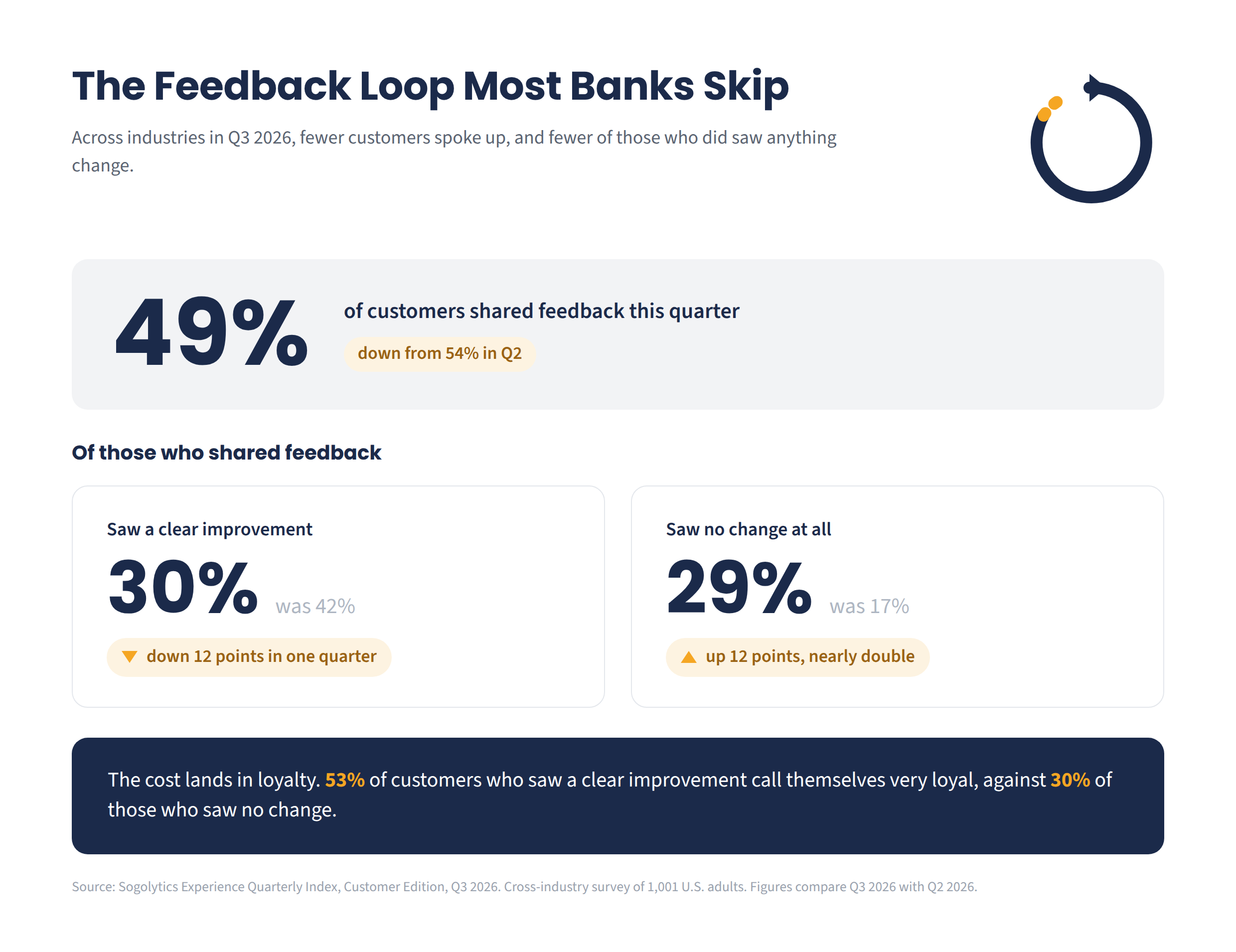
The fourth shift is where most programs falter, and the Q3 data shows the cost in plain numbers. Across industries, only 30% of customers who shared feedback said it led to a clear improvement, down from 42% the quarter before. Over the same three months, the share who saw no change at all nearly doubled, from 17% to 29%. Fewer people even bothered to give feedback: 49% this quarter, against 54% the quarter before.
There is a second finding in the same data that complicates the picture. As customers feel more heard, they get more demanding, not more forgiving. Among customers who call themselves loyal, 13% say they are very likely to switch after a single bad experience. Among disloyal customers, only 9% say the same. Once you have shown someone you can get things right, the next slip costs more than it would have before.
The money sits in that gap. In the Q3 Index, 53% of customers who saw a clear improvement from their feedback described themselves as very loyal, compared with 30% of those who saw no change. A bank that asks for feedback and then does nothing with it can end up worse off than a bank that never asked, because it has shown customers that speaking up leads nowhere.
Closing the loop is an operational job rather than a message from marketing. It means a signal that crosses a threshold triggers an owner, a decision, and a change, and that the customer sees proof of it. That is why experience operations lives closer to the operations floor than to the brand team. It is a workflow, with response times, named owners, and accountability, applied to how customers feel.
Governance is the Hard Part
The biggest challenge in experience operations is establishing clear ownership of problems that span departments. Even when banks have the tools to collect feedback and track issues, progress can stall if no one has the authority to coordinate a response across teams. For example, a bank may add app features while customer service continues to receive complaints about a confusing loan application process, leaving the underlying problem unresolved.
Digital transformation leaders can help bridge such gaps by connecting CX priorities with the systems, processes, and teams responsible for delivering them. Their role is to bring the right stakeholders together, align improvement efforts with business goals, and ensure that changes to technology and workflows address actual customer problems. They may not own every part of the experience, but they can help establish the accountability and cross-functional coordination needed to improve it.
Securing ongoing investment also requires a business case that reflects how experience operations creates value. Its impact may show up in customers completing applications they might otherwise abandon, fewer account closures, or lower contact center volume because recurring problems have been resolved. These gains may not appear as a new revenue stream, but they can protect existing revenue and reduce operating costs. By linking improvements to outcomes such as avoided churn, customer lifetime value, and service efficiency, banking leaders can make a stronger case for continued investment.
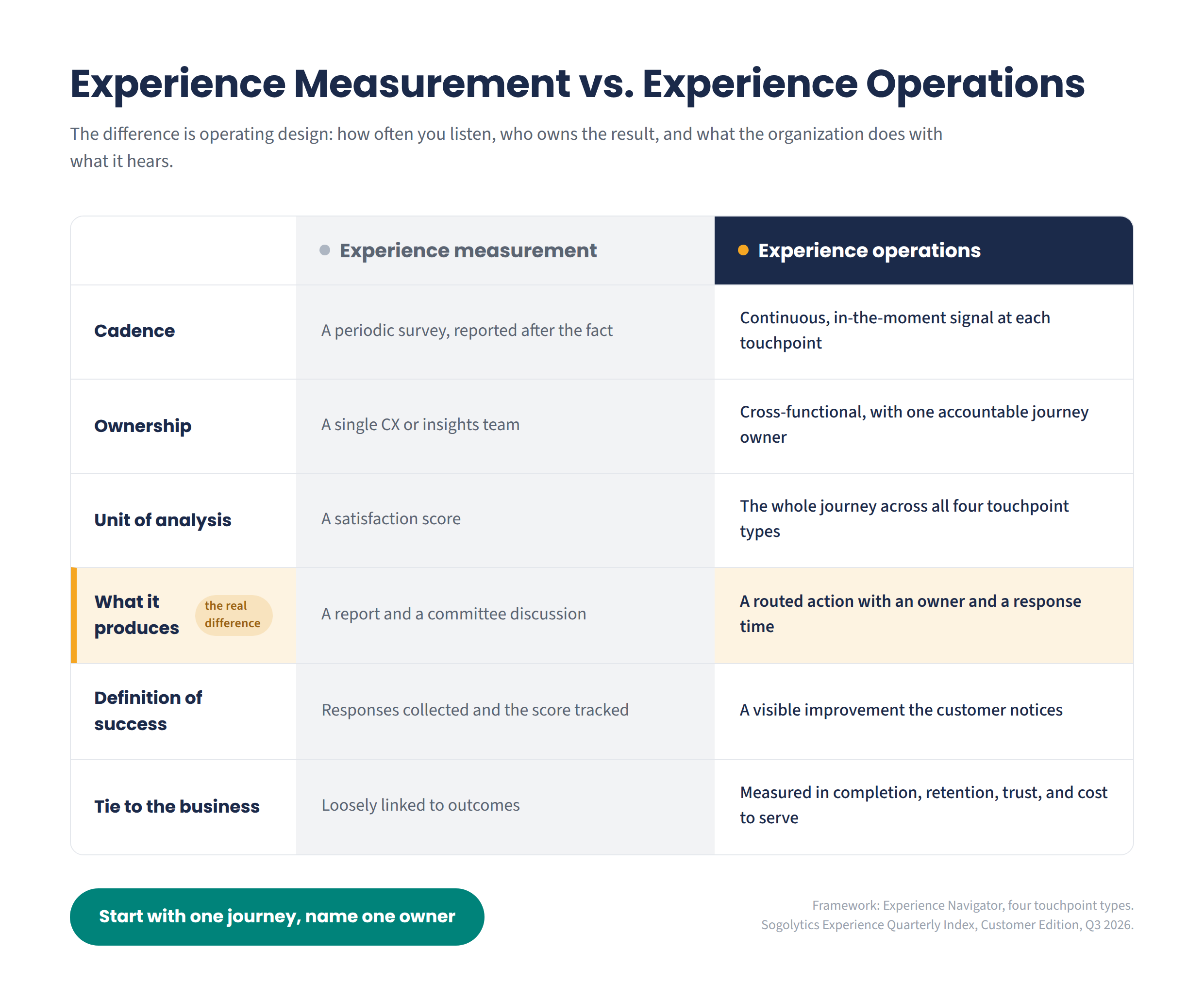
Experience Measurement vs. Experience Operations
The difference between the two approaches is easiest to see side by side. It comes down to design: how often you listen, who owns the result, and what the organization does with what it hears.
Where This Leaves Digital Banking Leaders
As digital banking features become increasingly similar, the ability to understand and improve the customer journey becomes a more meaningful source of differentiation. Banks need to move beyond tracking satisfaction scores and establish a process for identifying friction, assigning responsibility, and measuring whether changes improve customer outcomes. A framework such as Experience Navigator can help banks identify where to focus, but making those improvements stick requires clear ownership and coordination across teams.
Banks can start with one high-impact journey, such as account opening or loan applications. Assign an accountable owner, identify a few relevant measures, set expectations for resolving issues, and track the results over the next two quarters. Changes in application completion, complaint volume, and customer retention can help establish whether the approach is working and where further improvements are needed.
A customer experience program measures experience on a cycle and reports the result. Experience operations runs experience as a continuous discipline. It listens at each touchpoint in the moment, routes each signal to the team that can act, and closes the loop with a change the customer can see. The difference is in the design: how often you listen, who owns the outcome, and what the bank does with what it hears. The point of an operation is that something actually changes, at the place the change is needed.
Because collecting without acting chips away at the trust it was meant to build. In the Q3 2026 Index, only 30% of customers who shared feedback felt it led to a clear improvement, and customers who feel heard become more demanding, not more forgiving. Asking for input creates an expectation of a response. A bank that gathers feedback but never closes the loop can end up worse off than one that never asked, because it has shown that speaking up changes nothing.
Orchestration starts with one journey view that spans all four touchpoint types, instead of a separate scorecard per channel. Signals from each touchpoint get routed to the owner who can act, with clear rules for where automation handles routine load and where a person takes over. The aim is one coordinated relationship rather than a set of individually tuned channels that still add up to an inconsistent experience.
One accountable owner who sits across functions, usually a digital transformation or experience leader with the mandate to coordinate product, digital, operations, and the contact center. The customer experience or insights team supplies the measurement, but ownership of the operating model has to be explicit and cross-functional. Leaving experience as a shared responsibility with no named owner is the most common reason good feedback never becomes change.
Watch two layers. First, experience signals like effort, satisfaction, and trust at the touchpoint level, moving in the right direction. Second, and more telling, the closed-loop metrics: how many flagged issues led to a shipped change, how fast, and whether that touchpoint’s scores recovered afterward. A healthy operation also shows movement in business outcomes such as completion, retention, and cost to serve, not just a steady survey score.
Experience Navigator supplies the starting map an operating model needs. It lays out the journey across digital, physical, process, and human touchpoints, names the likely pain point at each, attaches the metric that exposes it, and recommends the feedback project that measures it. That gives a cross-functional team a shared, structured view to govern against, which shortens the distance from a scattered set of surveys to a coordinated operation.