



Travelers and diners have a clear sense of what their money should cover, and it is usually more than a business assumes. And with prices rising year after year, guests are paying closer attention to which fees feel justified and which feel like a penalty. For hospitality businesses, that leaves little room to recover margin by adding fees. But when it comes to the experience itself, guests are less willing to compromise. They still expect the basics they value to be included, even as they become more careful about what they pay for.
Sogolytics’ latest hospitality research highlights just how clear and established these expectations have become. Across airlines, hotels, and restaurants, 20% or fewer customers say they will pay more for a better experience, and a single surprise fee is enough to send large shares to a competitor. Most guests are not looking for more to pay for. They want to hold on to what they already count on, and they move to a competitor quickly when a business charges for it. That changes what a hospitality budget has to protect.


For leaders building their 2027 budgets, the question is no longer what else they can add, but what guests already expect them to get right. For much of the past decade, the instinct was to add amenities and assume guests would notice and reward the investment. That strategy becomes harder to justify when guests are not necessarily willing to pay more for added extras, but are quick to react when the basics they value come with an unexpected charge or fall short of expectations. The more precise task now is to identify the few failures that guests refuse to forgive and fund those ahead of anything else. Get one of these wrong, for example by charging for something guests expected to be free, and the cost rarely shows up at once. It surfaces later as an unsold room, a booking that goes to a competitor, or a public review that shapes a stranger’s decision.
Sogolytics’ recent study, The Non-Negotiables of CX in Hospitality, put these questions to 1,003 U.S. travelers and diners. It measured what earns a price premium, what customers now treat as standard, and how they respond when an experience disappoints them. Read together, the findings give leaders a practical map of where 2027 spending protects the most revenue.
The Five Non-Negotiables for Hospitality CX in 2027
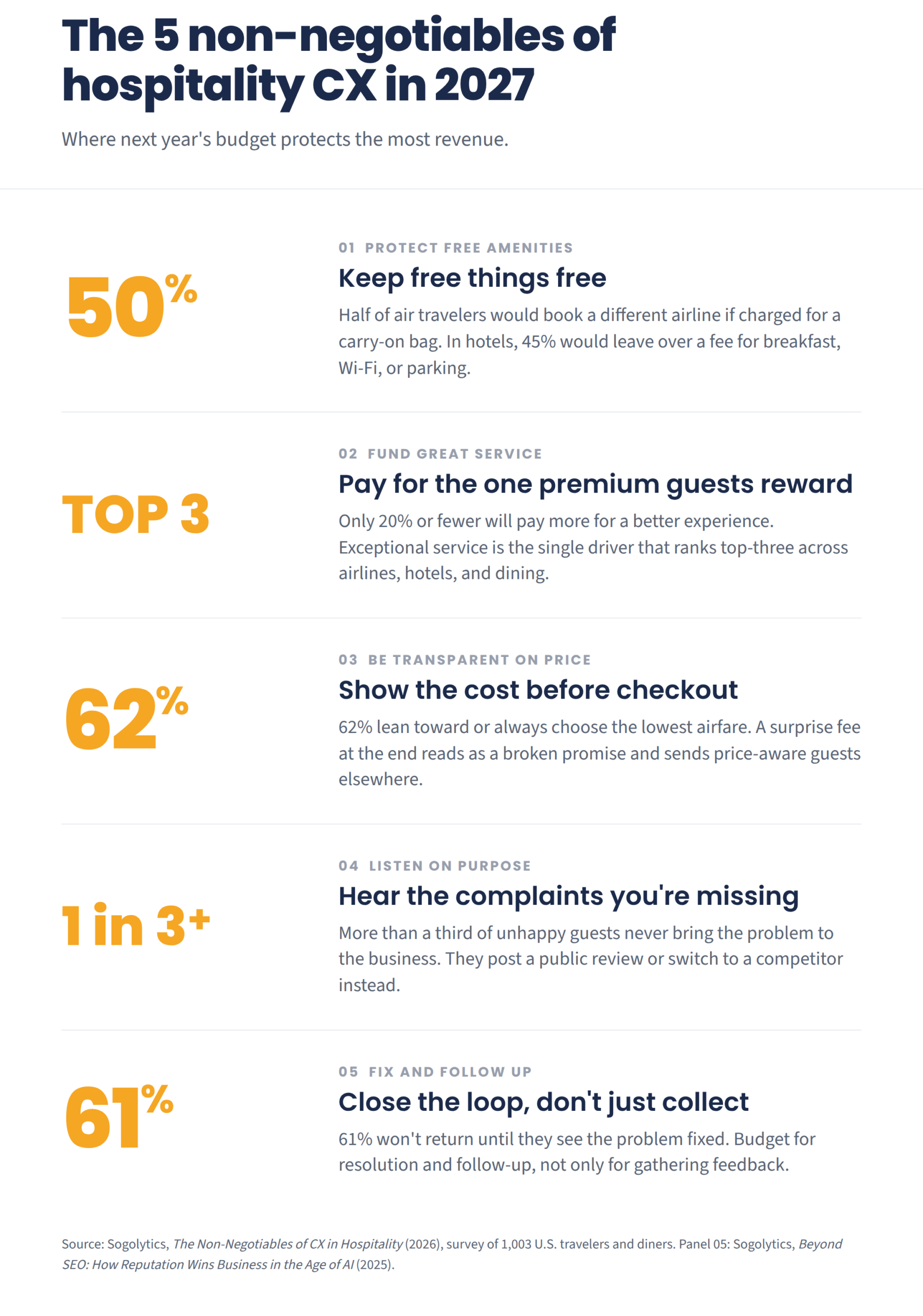
These five points come straight from how customers behave, not from a wish list. Each one carries a spending decision for the year ahead, and each one is tested hardest when demand is high and patience is short.
1. Treat free amenities as protected, not optional
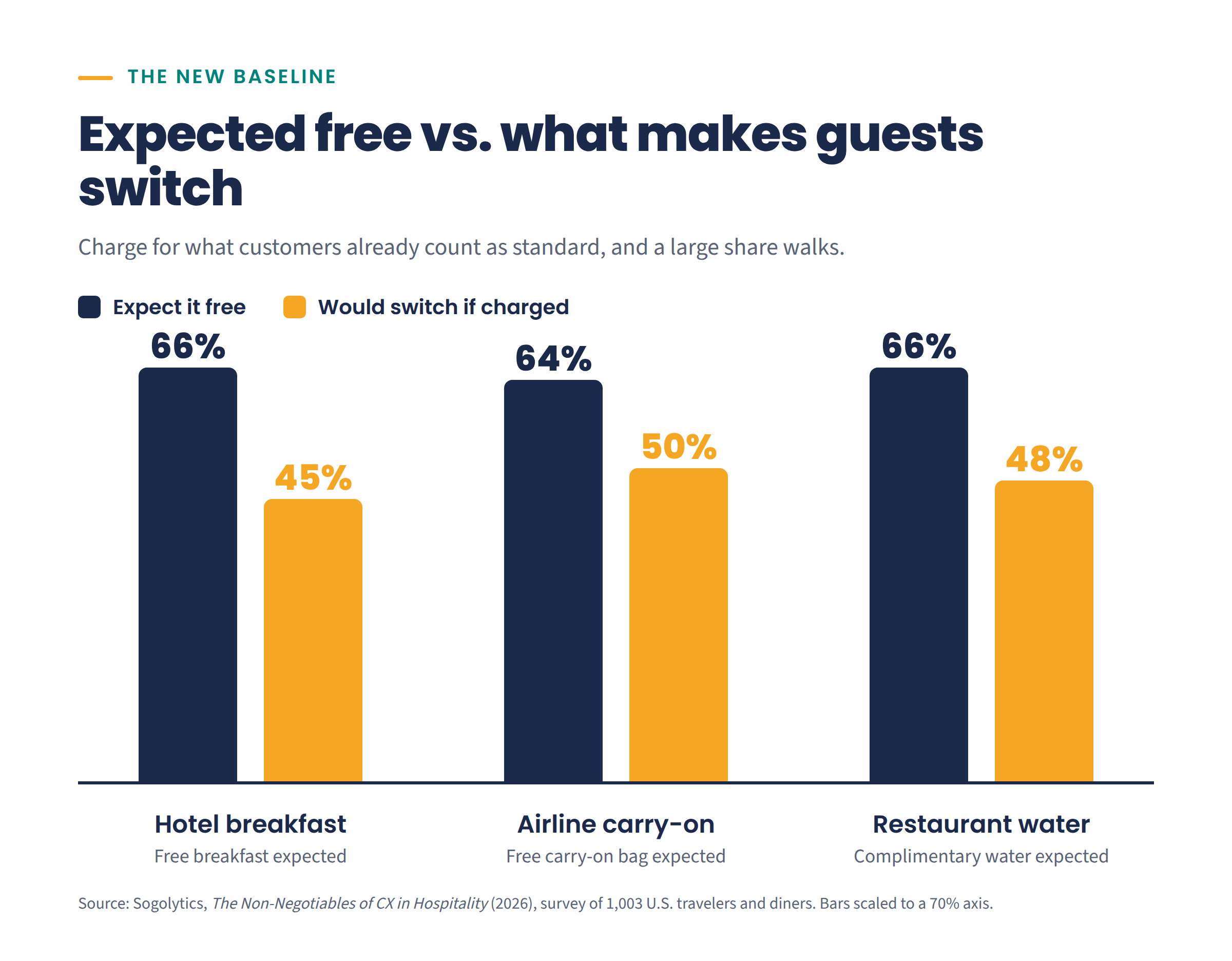
Some perks have moved beyond the “nice to have” category and become part of what customers consider a standard experience, which means charging for them can quickly change where they choose to spend their money. Among air travelers, 64% expect a free carry-on bag, and half say they would book with another airline if they had to pay for one. Another 42% expect a free checked bag, while 39% would look elsewhere if it came with an extra charge. Hotel guests show a similar pattern, with 66% expecting free breakfast and 65% expecting free Wi-Fi, while 45% say they would consider staying somewhere else if they were charged for breakfast, Wi-Fi, or parking.
For 2027, the question is not just what you can charge for. It is which extras customers already see as part of the stay. If a fee is likely to cost you more bookings than it brings in revenue, it may not be worth adding, especially during peak periods.
2. Fund service, because it is the one thing most people will pay extra for
Our study found that customers will not pay a premium just for a better overall experience. Across all three industries, 20% or fewer said they would pay a higher price for one. The willingness to spend more is real but narrow, and it concentrates in a single area.
When customers were asked what matters most to them, great customer service stood out. It ranked among the top three factors in all three industries, coming in second for hotel guests and third for both air travelers and diners.
In other words, customers may not want to pay a lot more for the overall experience, but they clearly value good service. Think of a restaurant that keeps service fast and friendly on its busiest night, when every table is full. Or a hotel team that stays calm and helpful when a weather delay strands a lobby full of travelers. These are the moments guests remember and are more likely to reward with a return visit.
That is why staffing, training, and service recovery matter even more during busy periods. The aim is to keep the service customers value most from slipping when demand is at its highest, whether or not you charge a premium for it.
3. Put price transparency in the budget, not just the fine print
In the Hospitality CX Report, we found that price plays a big role in how travelers choose where to spend. In the Hospitality CX Report, 62% of travelers said they lean toward or always choose the lowest airfare, while 52% said the same about hotels.
When customers are this focused on price, unexpected fees can quickly change how they feel about the purchase. That matters even more during the holidays, when people are already watching their spending.
The report points to a simple fix: if a fee cannot be avoided, show it early. An airline that displays its holiday baggage fee while customers are comparing flights gives them a clear picture of the real cost. The same applies to a resort fee. Showing it during booking is very different from revealing it when the guest arrives.
For 2027, focus on making prices clear from the start. Review booking flows, show required fees early, and give staff simple ways to explain costs when customers have questions. It is much easier to set expectations upfront than to rebuild trust after an unexpected charge. Thus, a clean customer journey design is cheaper than winning a guest back after a bad surprise.
4. Budget to hear the complaints you are currently missing
Many unhappy customers never tell the business what went wrong. When something goes wrong, 57% tell the business first, but 20% post a public review before saying anything to the company, 17% tell only friends or family, and 6% do nothing. Overall, 30% of customers have posted a negative review without ever telling the business. That rises to 45% among airline customers, 50% among 18-to-24-year-olds, and 70% among business travelers.
That makes it harder for businesses to fix problems while they still can. A guest who has a bad stay may say nothing at the front desk, then post about it later when other travelers are already planning their trips. A simple post-stay survey gives them a chance to share what went wrong directly with the business.
For 2027, travel and hospitality brands should make feedback a natural part of the customer experience rather than something that happens only after it is over. That means giving customers opportunities to share their thoughts while the experience is still fresh, both during their stay or journey and afterward. When a brand hears about a problem early, it has a better chance of resolving it before frustration turns into a public review or a lost customer.
5. Set aside budget for fixing and following up, not just collecting
Collecting feedback is only the beginning. What a business does with that feedback can determine whether a guest is willing to return. In a related 2025 Sogolytics study, Beyond SEO: How Reputation Wins Business in the Age of AI, customers whose negative reviews went unanswered were clear about what they needed to see before giving the business another chance: 61% said the business would need to show that the problem had been fixed, 49% wanted a clear explanation of what went wrong, and 37% said they would not return at all.
That makes the response to feedback just as important as collecting it. For 2027, hospitality leaders should consider how their budgets support the processes behind that response, from resolution workflows and staff empowered to address problems in the moment to follow-up that shows customers their feedback led to action. This is where the experience management lifecycle becomes more than a framework, helping turn customer feedback into better experiences, repeat bookings, and stronger loyalty.
What Guests Do After a Bad Experience
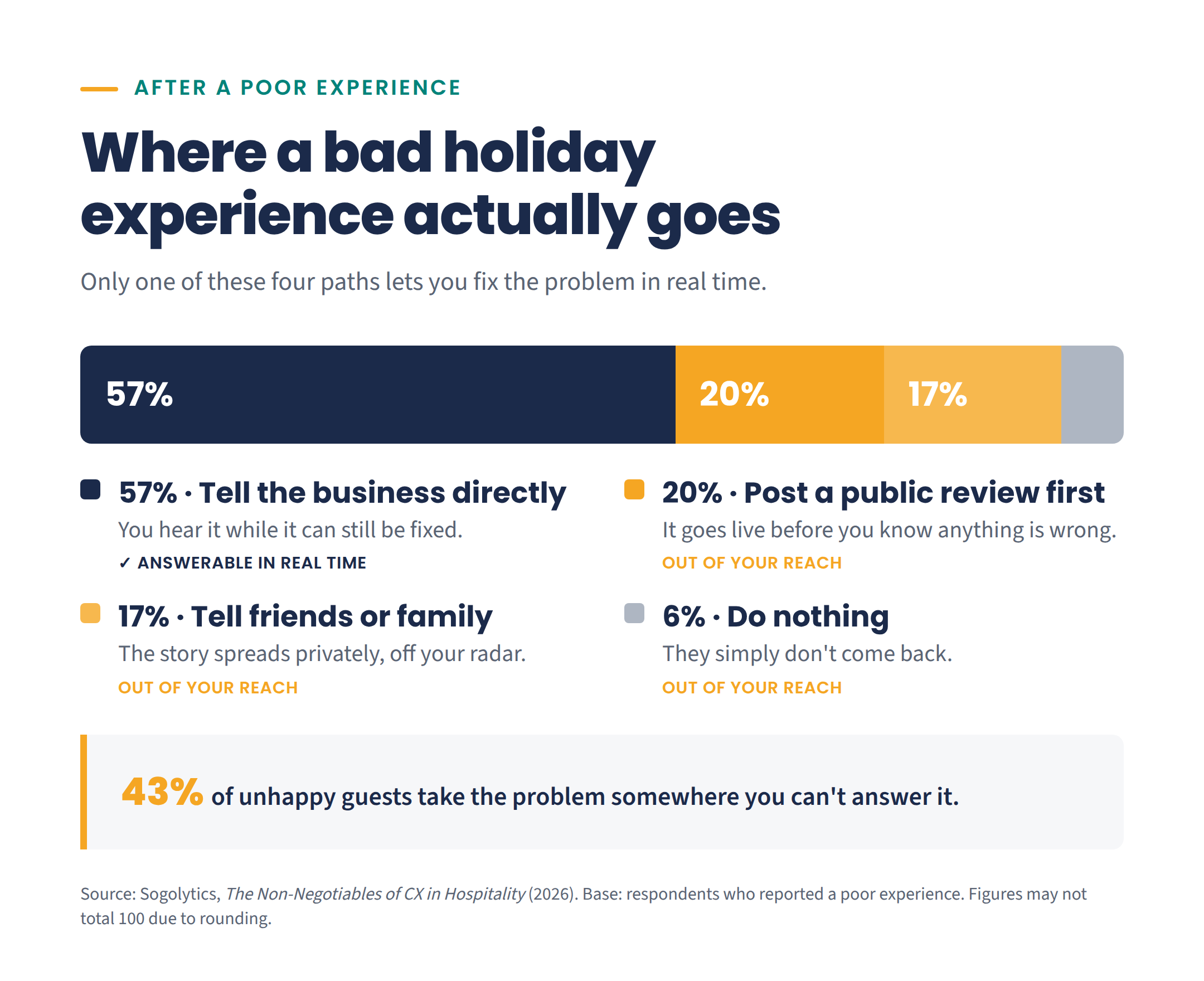
When a guest has a poor experience, the business does not always get the opportunity to address it directly. According to the study, 57% of customers tell the business first, while 20% post a public review before reaching out, 17% share the experience only with friends or family, and 6% say nothing at all. In other words, more than a third of unhappy customers never give the business a chance to respond before sharing or simply moving on.
That gap matters because a negative experience can influence other customers long before the business knows there was a problem. A review posted online can shape the next traveler’s or diner’s decision, while an experience shared privately can affect recommendations within a customer’s own network. For hospitality brands, creating more opportunities to hear from unhappy guests directly is essential to addressing problems before they have a chance to affect future business.
For 2027, Hospitality Brands Need to:
1. Build feedback into the customer journey.
2. Give customers an easy way to raise an issue during their stay or visit.
3. Follow up shortly afterward.
4. Make sure someone owns the response.
The goal is not to prevent every bad experience. It is to hear about problems early enough to do something about them.
Conclusion
Most operators already have a sense of where the experience needs attention. The harder part is translating those priorities into clear budget decisions and assigning ownership across the full guest journey, from booking and arrival through the stay, dining, and post-checkout follow-up. When each stage is managed in isolation, it becomes harder to see how a problem in one part of the journey can affect the overall experience and, ultimately, whether a guest returns.
Consider a mid-size hotel group heading into 2027 with a mix of business and leisure properties. Its teams manage everything from booking and front-desk interactions to housekeeping, dining, and post-stay follow-up, with a shared goal of protecting repeat bookings and referral revenue. Rather than evaluating each touchpoint separately, the group needs a view of how those experiences connect and where a small investment could have the greatest impact. That is the kind of broader view a structured approach like Sogolytics’ Experience Navigator is designed to support. By looking across digital, physical, process, and human touchpoints, it can help teams identify where expectations are falling short and focus resources where they are most likely to improve the guest experience. It does not replace business judgment. It gives leaders a clearer picture to make those decisions.
The five that matter most, based on Sogolytics research, are protecting free amenities guests now expect, funding great service, being transparent about pricing, actively collecting feedback instead of waiting for it, and following up to fix problems. These are the areas where spending protects repeat business.
Charging for a carry-on bag would send half of air travelers to a different airline, and 39% would switch if charged for a checked bag. In hotels, charging for breakfast, Wi-Fi, or parking would each move 45% of guests. In restaurants, charging for water would send 48% elsewhere. These perks now read as standard, not extras.
Most will not pay more for much: 20% or fewer said they would pay a higher price for a better experience. The exception is service. A reputation for exceptional customer service was the only premium driver to rank in the top three across airlines, hotels, and restaurants, which makes it the safest place to charge a premium.
According to the Sogolytics’ study, more than a third of customers with a poor experience never tell the business. Some post a public review first, some tell only friends or family, and some do nothing. Business travelers, younger guests, and airline customers are the least likely to complain in person and the most likely to post about it in public.
Fund the amenities guests expect for free, invest in service quality and staff at peak periods, build clearer pricing into booking and checkout, implement systems for active listening, and set aside budget for fixing issues and following up. Each dollar protects loyalty rather than adding a perk few will pay for.