



Customers have grown accustomed to shopping on their own terms. They like browsing a store without being interrupted by a salesperson, or using an app to check products, compare prices, make a payment, and choose a delivery slot without having to speak to anyone. Retailers have embraced this shift too, investing in self-service options and digital tools that give shoppers greater control over their purchases.
But the convenience of shopping independently comes with an expectation: when something goes wrong, getting help should be just as easy. A delayed order, a damaged product, or a refund that never arrives can quickly change the experience. And when customers have to navigate outdated help articles, wait for an agent, or explain the same problem across multiple channels, the convenience they enjoyed while shopping can quickly disappear.
This is where retail customer support has a bigger role to play than simply resolving complaints. It needs to carry the same ease and consistency that retailers work hard to build into the shopping experience. Because while a smooth purchase can bring a customer through the door, how a retailer handles problems afterward can determine whether that customer comes back.


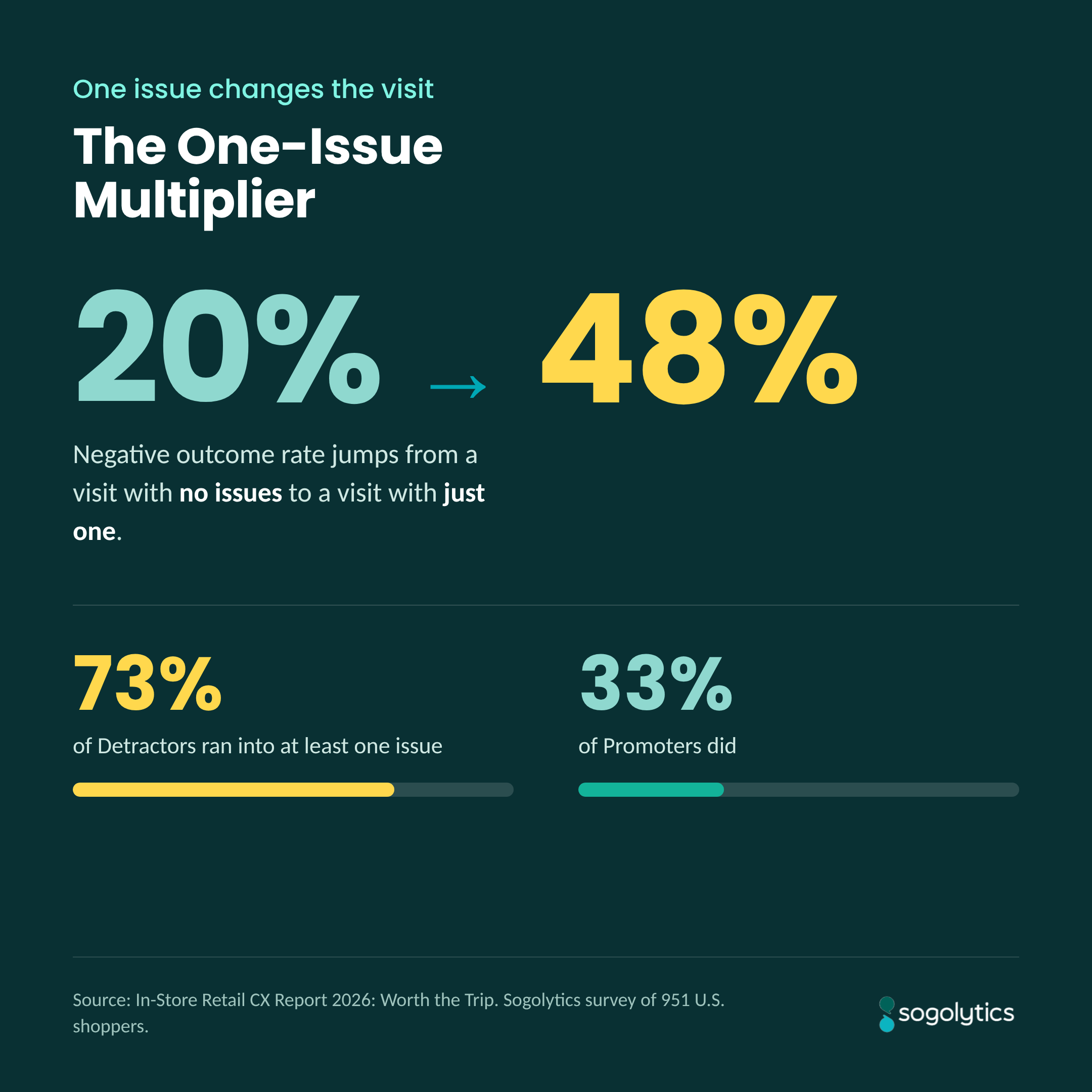
The findings from Sogolytics’ In-Store Retail CX Report 2026: Worth the Trip show how quickly one problem can change a shopping experience. The negative outcome rate increased from 20% among shoppers who experienced no issues to 48% among those who encountered even one. In other words, a single problem more than doubled the likelihood of an unhappy outcome, a reduced purchase, or a lost customer.
For retailers, this makes customer support more than a service function. It is an opportunity to address problems before they affect the next purchase.
Why Support is the Moment That Can Decide Loyalty
A customer rarely contacts support because everything is going well. Something has interrupted the shopping experience, and the customer needs the retailer to put it right. Hence, the way the brand responds can either restore confidence or make the original problem worse.
The In-Store Retail report offers another view of this relationship. Among shoppers classified as Detractors, meaning those unlikely to recommend the store, 73% had experienced at least one issue during their visit. Among Promoters, that figure was just 33%. Employee-related problems were also more common among Detractors, appearing in 26% of their visits compared with 14% across all shoppers.
These findings point to a connection between everyday service problems and how customers view a retailer. A product issue, an unclear policy, or an employee who cannot provide the right answer may seem like a small operational problem. For the customer dealing with it, however, that interaction becomes part of their judgment of the brand.
Consider a customer who receives a damaged mobile phone. A quick replacement, with no unnecessary paperwork or repeated calls, can leave them confident about buying from that retailer again. But having to follow up repeatedly, explain the issue to several support agents, and wait days for an update can overshadow the entire purchase experience.
Both situations began with the same problem, but the way the retailer handled it shaped the customer’s confidence in the brand. A smooth resolution can preserve the relationship, while a frustrating one can give the customer a reason not to return.
When Self-Service Creates More Work for Customers
Self-service is an important part of modern retail support. Customers should be able to check an order, understand a return policy, or find product information without waiting for an agent. When these tools provide the right answer, they save time for both the customer and the support team.
The problem begins when retailers treat self-service as a substitute for good support rather than another way to deliver it.
Two issues are particularly common. The first is outdated information: A retailer may change its return policy, shipping partner, or product range without updating the related help articles. Customers following those instructions may end up taking the wrong steps or contacting support to clarify something that should have been explained online.
The second is poor search functionality: For instance, a customer looking for instructions on exchanging a gift without a receipt should not have to work through unrelated articles about shipping and refunds. If the help center cannot understand the question or direct the customer to the right information, it has added another step to an already difficult experience.
This problem is closely related to product discovery. When customers cannot find the products or information they need, they are more likely to abandon the process or seek help elsewhere. The cost of unclear information can also extend beyond support contacts. In the In-Store Retail report, only 50% of shoppers who found the final price unclear said they would return, compared with 90% of those who found it clear.
What retailers can do: Review help-center content whenever a product, policy, or process changes. More importantly, test the search function using the questions customers actually ask. Internal product names and company terminology may make sense to employees, but customers are more likely to search using everyday language.
5 Support Breakdowns That Push Customers Away
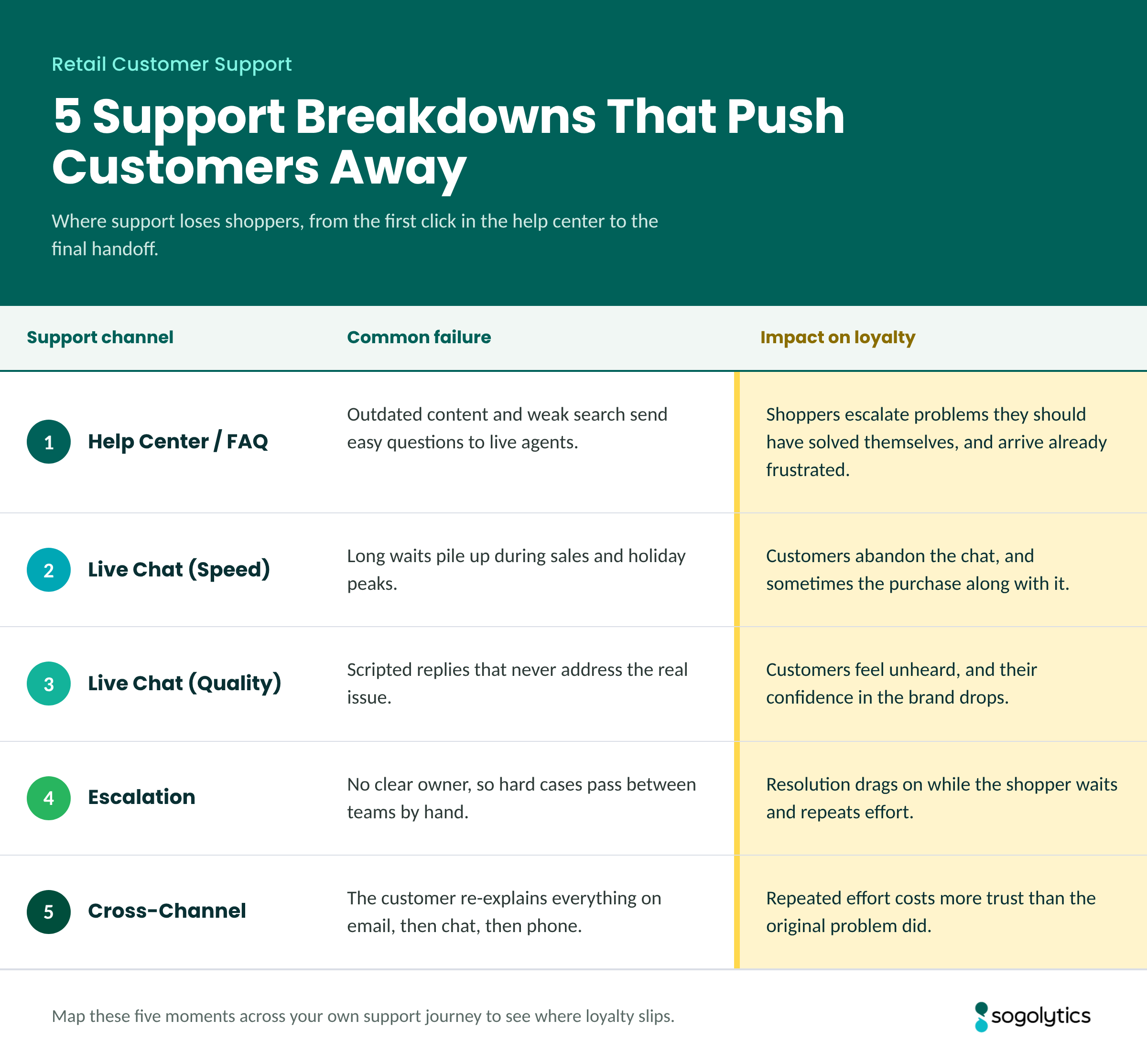
Most poor support experiences are not caused by one major failure. They develop through smaller problems that make it harder for customers to get a clear answer or reach someone who can help. Five areas deserve particular attention.
1. Outdated or difficult-to-search help content
When customers cannot find accurate information, they turn to live support for answers that should already be available. This increases contact volumes and makes customers do more work. Retailers should assign responsibility for keeping help content current and review it whenever policies, products, or delivery processes change.
2. Long waiting times on live channels
A customer who has already spent time trying to solve a problem is unlikely to welcome another long wait. This becomes especially important during major sales, product launches, and holiday shopping periods, when support demand can rise sharply. Retailers need to plan staffing around actual contact volumes rather than assume that demand remains steady throughout the day.
3. Responses that follow scripts but miss the problem
Standard replies help agents maintain consistency, but they should not prevent them from addressing the customer’s actual concern. Sending a customer a general return-policy link when they are asking why their refund has not arrived does little to move the issue forward. Support needs to provide relevant answers, not simply send a response.
4. Escalations without clear ownership
Some issues require input from billing, delivery, store operations, or another department. Problems arise when each team assumes someone else is responsible for resolving the case. Customers should not have to follow up repeatedly just to find out who is handling their request. Every escalation needs a clear owner and a defined process for updating the customer.
5. Requiring customers to repeat information across channels
A customer may start with email, move to chat, and eventually call because the first two attempts did not resolve the issue. Having to explain the same problem each time adds effort and gives the impression that the retailer does not have a complete view of the interaction. Support channels need to share customer history so agents can continue the conversation rather than start it again.
Live Support Needs Both Speed and the Right Response
Getting a customer through to an agent quickly is important, but speed alone does not make an interaction successful. Customers also need to speak with someone who understands the issue, has access to the right information, and can take responsibility for resolving it.
The In-Store Retail report highlights two areas where employee interactions can fall short. Among shoppers who interacted with an employee, 18% said staff did not have enough knowledge to help them, while 14% felt employees approached them more often than they wanted.
The findings suggest that better service is not necessarily about increasing the number of employee interactions. It is about making those interactions useful. A shopper comparing two products may want time to decide, while someone dealing with a billing error needs an employee who can explain the charge and help resolve it.
The same principle applies to online support. A chatbot that repeatedly interrupts a customer who is browsing can be just as unhelpful as a support team that is difficult to reach when a customer needs assistance.
Retailers need to understand when customers want help, which questions employees should be equipped to answer, and when an issue needs to move to another team.
What retailers can do: Use customer feedback to identify where agents struggle to answer questions or resolve problems. Combine that information with training and coaching and give employees enough access and authority to handle common issues without unnecessary handoffs.
The Escalation and Cross-Channel Problem
A customer does not think about support in terms of departments, channels, or internal systems. They see one retailer and expect that retailer to know what has happened so far.
Yet many support operations still work in separate channels. The email team may not have access to the chat history, and the phone agent may not know that the customer has already contacted the company twice. This creates a situation where the customer has to manage the communication between teams.
The problem becomes more serious when an issue needs to be escalated. A customer waiting for a refund, for example, should not have to contact the retailer again just to find out whether the billing team has received the request. The original issue may be relatively simple, but poor coordination can turn it into a prolonged experience.
This is where a connected omnichannel customer experience matters. Whether customers contact a retailer through email, phone, chat, or an in-store service desk, the teams handling those interactions should have access to the relevant history.
A shared customer record can help agents understand previous conversations, actions already taken, and any outstanding requests. It also makes it easier to provide consistent information across channels.
Retailers should look beyond whether they offer multiple support channels and examine whether those channels work together. Having several ways to contact a company does not automatically make support convenient. Customers benefit when they can move between channels without having to explain their situation again.
4 Metrics That Show Whether Support Builds or Breaks Loyalty
Support teams often rely on average handling time, first response time, and ticket volumes to measure performance. These figures help managers understand how efficiently the team operates, but they do not show whether customers are satisfied with the outcome.
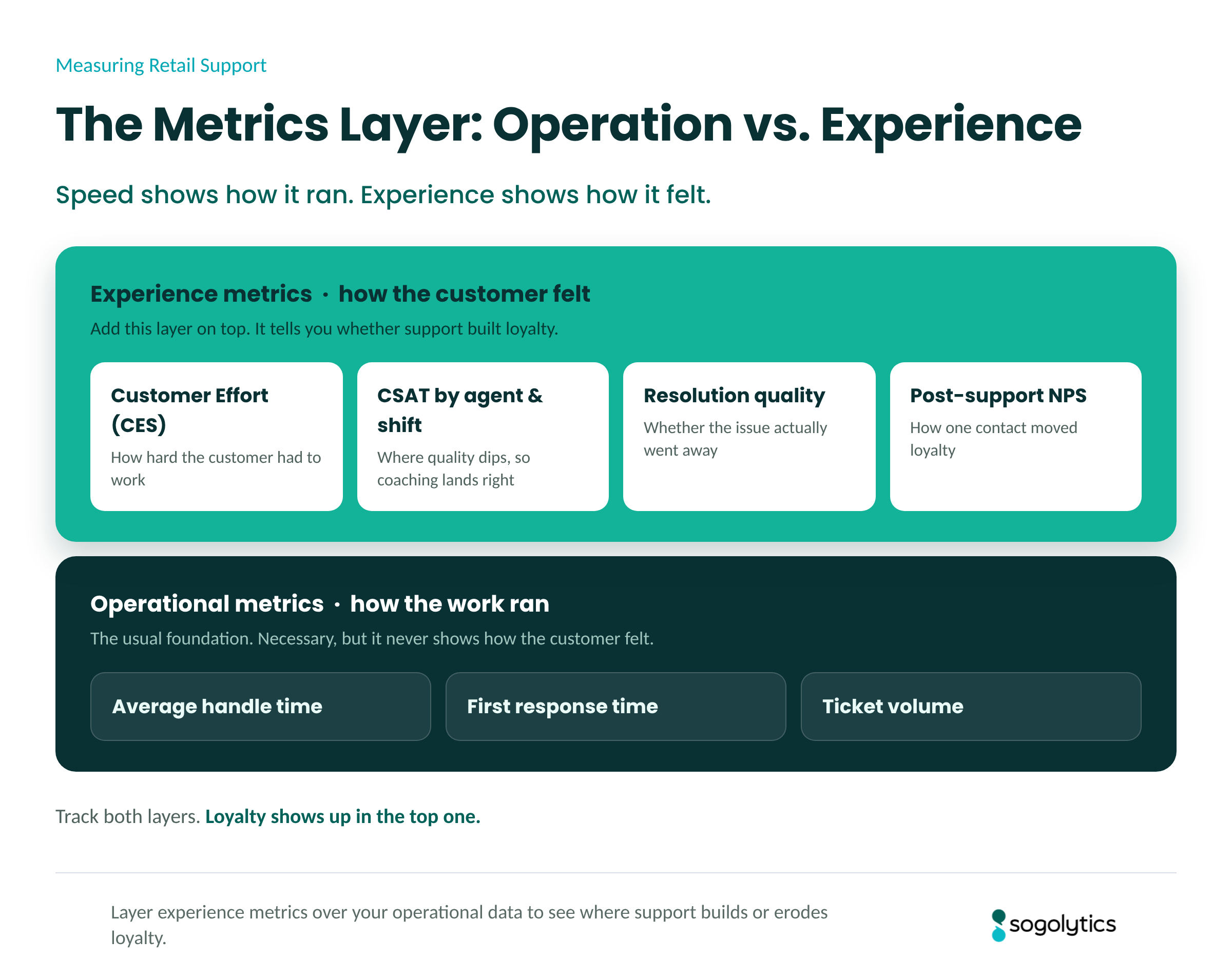
A ticket can be closed within a few minutes even when the customer still has an unresolved problem. To understand the quality of support, retailers need to measure what happens from the customer’s perspective as well.
Four metrics can help provide that picture.
1. Customer Effort Score (CES)
CES measures how easy or difficult it was for customers to get their issue resolved. It can reveal problems such as repeated information requests, unclear instructions, and unnecessary transfers between teams. A high-effort experience is a sign that the support process needs attention, even if the team meets its response-time targets.
2. Customer Satisfaction (CSAT) by agent and shift
Overall satisfaction scores can hide differences in service quality across teams and working hours. Reviewing CSAT by agent, shift, and support channel helps managers identify where customers are receiving inconsistent assistance and where additional training or staffing may be needed.
3. Resolution quality
Closing a ticket does not necessarily mean the problem has been solved. Retailers should check whether the customer received the promised outcome and whether the same issue required another contact. This helps distinguish between a quick response and a successful resolution.
4. Post-support Net Promoter Score (NPS)
Measuring NPS after a support interaction can help retailers understand whether that experience changed the customer’s willingness to recommend the brand. It should be considered alongside overall relationship NPS, since a single interaction and the broader customer relationship measure different things.
For context, the In-Store Retail report recorded an overall NPS of 35 for physical retail. Tracking support-related feedback alongside this broader measure can help retailers understand where individual interactions are strengthening or weakening customer relationships.
5 Ways to Make Retail Support a Stronger Part of the Customer Experience
Improving support does not always require a new platform or a larger team. In many cases, the bigger opportunity is to fix the processes that make customers work harder than they should.
Here are five practical steps retailers can take.
1. Keep self-service information accurate and useful
Review help articles whenever policies, products, or delivery processes change. Test common customer questions to see whether the search function leads to the right answer, and make sure customers can reach a person when self-service is not enough.
2. Match staffing to customer demand
Use historical contact volumes to identify busy periods across chat, phone, and email. Plan staffing around those patterns, particularly during sales and other high-demand periods, so customers are not left waiting when they need assistance.
3. Train agents to understand the problem, not just follow a script
Give employees clear guidance on policies and procedures but allow them to respond to the situation in front of them. Agents should be able to explain what went wrong, what can be done, and what the customer can expect next.
4. Assign ownership to every escalation
Establish clear responsibility when a problem moves between departments. Customers should know who is handling the issue, when they can expect an update, and what happens if the expected resolution is delayed.
5. Connect support channels and customer records
Give agents access to relevant interaction history, so customers do not have to repeat information. This also helps teams understand recurring problems and identify where a process is failing across multiple channels.
Retailers should not try to fix everything at once. Start with the issues that generate the most customer complaints or repeat contacts, establish a baseline, and measure whether the changes improve resolution quality and customer effort over time.
Where Experience Navigator Fits
Knowing that support needs improvement is one thing. Identifying exactly where customers encounter problems across the journey is another.
Experience Navigator helps retailers examine their customer experience across four areas: industry, business model, operational scope, and business objectives. For support teams, this means looking at the channels customers use, the processes behind those interactions, and the outcomes the business wants to improve.
This wider view can help retailers identify issues that individual support metrics may not reveal. A rise in order-tracking queries, for instance, may point to a problem with delivery updates rather than the performance of the support team. Repeated questions about refunds may indicate that the policy is unclear or that customers cannot see the status of their requests.
By connecting feedback to specific stages of the customer journey, retailers can identify the source of recurring problems instead of treating every complaint as a separate support case. This is also why retail feedback programs need to capture feedback at the points where customers actually experience the brand.
Customer support will always involve situations where something has gone wrong. Retailers cannot prevent every delivery delay, damaged product, or billing error. What they can control is how much effort customers have to make to get those problems resolved.
The goal should not be to make every support interaction faster at the expense of the outcome. It should be to make it easier for customers to get the right answer, reach the right person, and move on with confidence. That is what turns a support interaction from a cost of doing business into a reason for customers to return.
Customer support influences how customers view a retailer when something goes wrong. A quick, helpful resolution can restore confidence and encourage repeat purchases, while long waits, unclear answers, and repeated follow-ups can push customers toward competitors.
Common problems include outdated self-service information, long waiting times, scripted responses that do not address the issue, unclear escalation processes, and disconnected support channels that require customers to repeat information.
Retailers should keep help-center content updated, use search terms that reflect how customers ask questions, and make sure the information is easy to follow. They should also provide a clear way to contact an agent when self-service cannot resolve the issue.
Retailers should track operational measures such as first response time and average handling time alongside Customer Effort Score, Customer Satisfaction, resolution quality, and post-support NPS. Together, these measures show both how efficiently the team operates and how customers experience the service.
Omnichannel support connects customer interactions across phone, email, chat, and other channels. When agents can access the same customer history, shoppers do not have to repeat their problems every time they switch channels, making it easier to get consistent answers and resolve issues.