



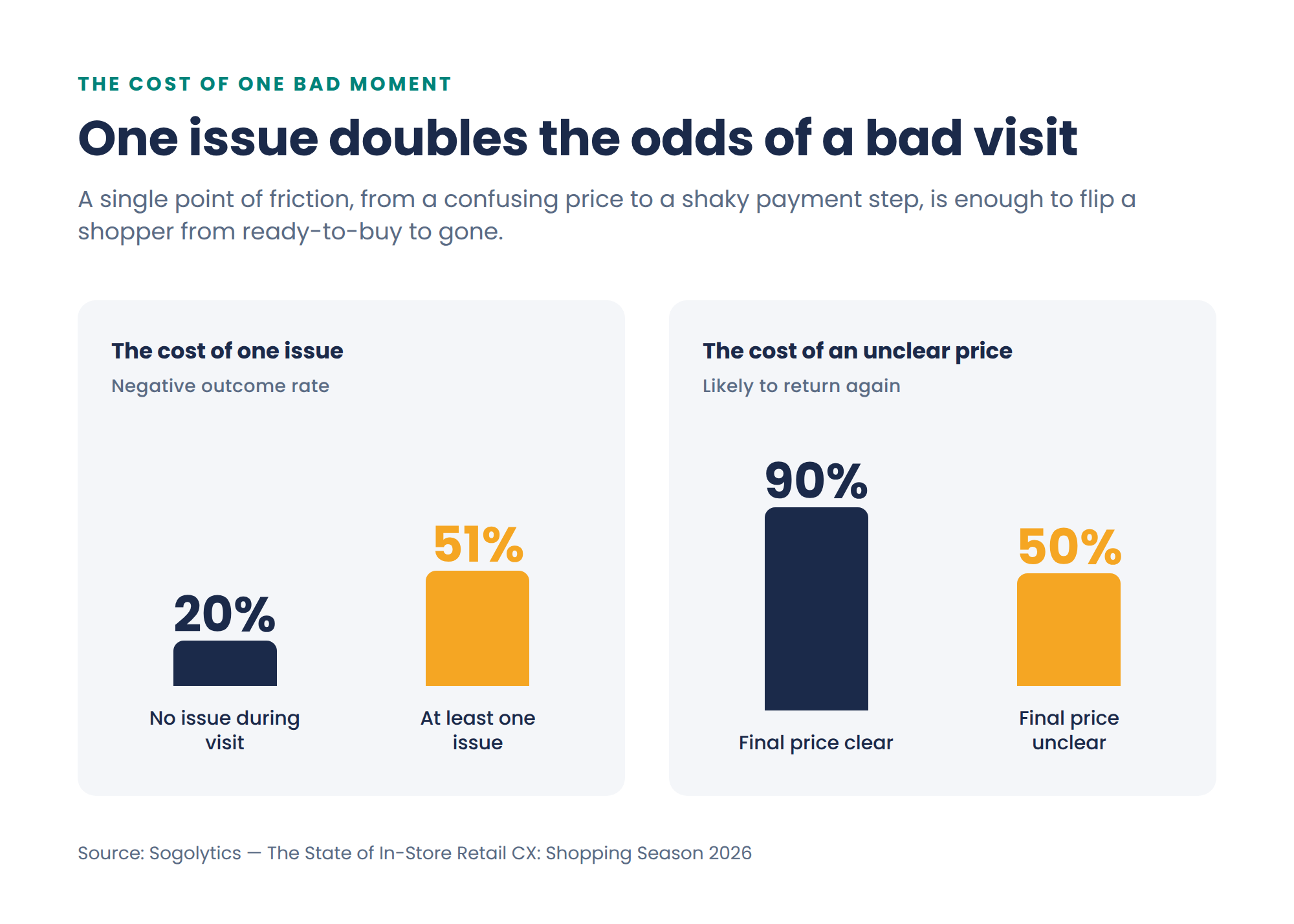
For most retailers, the holiday weeks decide the year, and they also expose every weak point in the buying journey at once. Higher traffic means more chances for something to go wrong at the moment a shopper is ready to pay. The State of In-Store Retail CX: Shopping Season 2026, a Sogolytics survey of 951 U.S. adults, found that a single issue during a visit more than doubled the odds of a bad outcome, from 20% to 51%. One stumble was often all it took to lose the sale.
At checkout, that stumble is usually about trust. A payment page with no visible sign of safety, a login that will not cooperate, or a fraud check that turns away a good customer can each cost a sale that was nearly complete. Trust is not only about how secure your systems really are. It is also about whether the customer believes they are safe, which is the part most teams never measure.
This blog breaks down where that belief is won or lost, and what leaders can do about it before the busiest days arrive.
Where Perceived Safety Comes From
Ask a payments team how secure the checkout is, and the answer arrives backed by certifications, audits, and a stack of controls. But ask a shopper the same question, and the answer comes from somewhere far less technical:
- How the page looks
- How many times it asks for the same details
- How carefully it handles payment card information
Those impressions form in seconds, and they carry as much weight as any encryption standard.
The practical takeaway for a retail leader is uncomfortable but useful. You can invest heavily in security and still lose the sale if the experience fails to communicate that safety at the moment it matters. During Black Friday and the weeks that follow, when many buyers are meeting your brand for the first time through a deal, that communication gap is at its widest.


Five Places Where Trust Breaks Down in the Holiday Rush
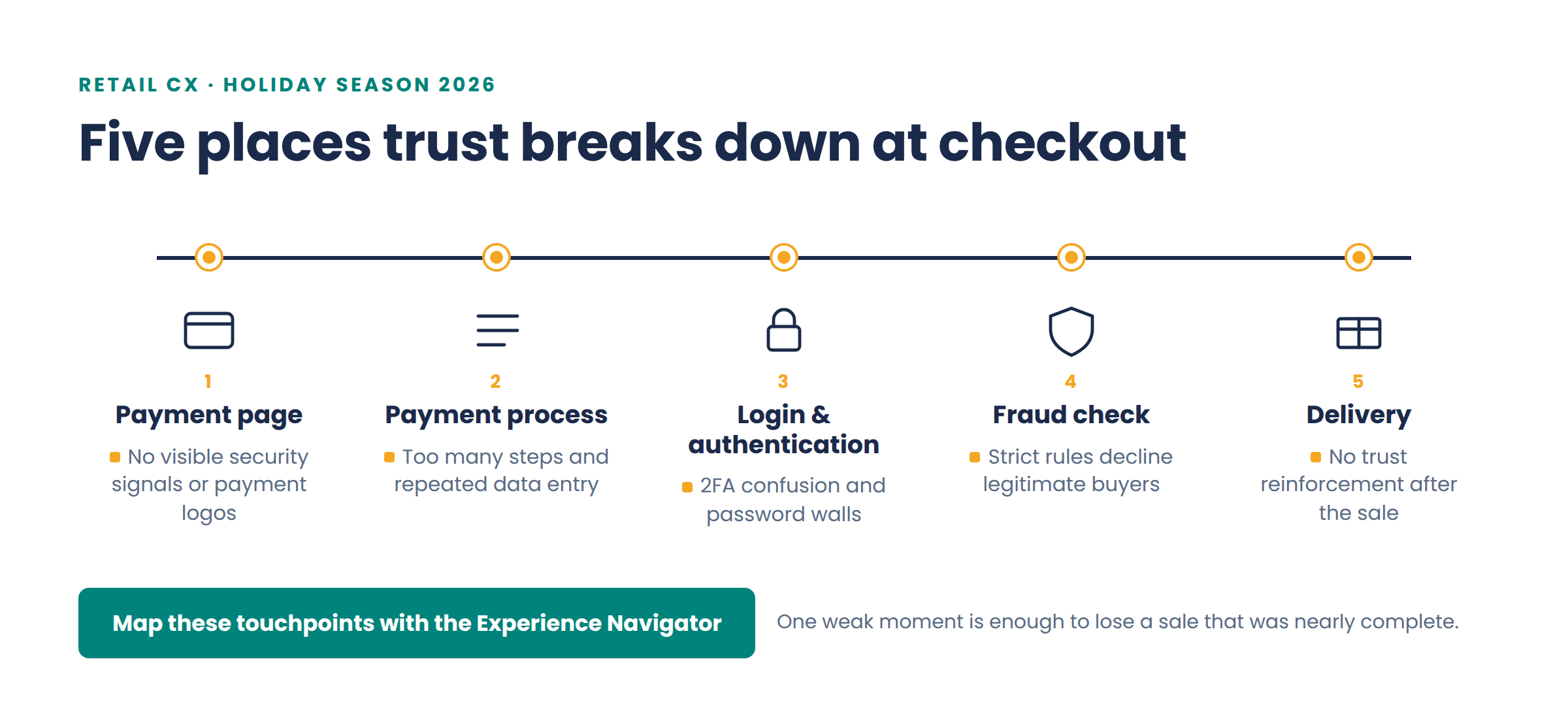
Trust rarely collapses at once. It erodes at specific moments; most of them clustered around payment and login. Here are the five that cost retailers the most, and what each one looks like to the shopper standing in it.
1. The payment page that shows no sign of safety
The payment screen is the highest-stakes moment in the journey, because it is where card numbers and billing details finally change hands. When the page carries no recognizable payment logos, no clear security cue, and no plain statement about how data is handled, the shopper is left to judge the risk alone. A first-time visitor who arrived through a Black Friday ad has no history with the brand to lean on, so a bare payment page is often all it takes to send them somewhere that feels safer.
2. The checkout that asks for too much
Every extra step is another opening for second thoughts. Long forms, repeated requests for the same information, and vague error messages pile effort onto the exact moment the shopper wants to be finished. Consider a gift buyer working through their phone on a lunch break in early December, where the mobile checkout adds friction of its own. If the flow makes them re-enter an address they already gave, or throws an unclear error after they tap pay, they cannot tell whether the order went through, and that uncertainty produces duplicate charges, support tickets, and abandoned carts.
3. The login that gets in its own way
Most retailers treat authentication as a security task and stop there. Shoppers experience it as an obstacle. Two-step verification that appears on one visit but not the next, or a code that expires before it can be typed, makes people wonder whether the system is working at all. Password rules that demand length and symbols without guidance produce failed logins. A returning customer trying to check an order status in the middle of the holidays, locked out of their own account, hits a wall of doubt before the real task even begins.
4. The fraud check that punishes good customers
Fraud tools protect the business, but overly strict rules can also block legitimate customers. When a genuine shopper is declined without a clear explanation or an easy way to resolve the issue, the experience can erode trust and send them elsewhere. The holidays increase the risk because shoppers are more likely to ship gifts to new addresses and make larger purchases, both of which can trigger fraud checks. Setting a threshold that stops fraud without blocking honest buyers is one of the most consequential calls a retail team makes all season, and it cannot be made well without feedback from both the approved and the declined.
5. The delivery that forgets to close the loop
Trust does not end when the payment is cleared. For online orders, the box on the doorstep is one of the few times the brand appears in the customer’s hands. A package that arrives with no word on how their data is protected, or in sloppy, off-brand materials, wastes a chance to confirm the promise the website made. A short insert on data handling, or clean branded packaging, tells the shopper the care they saw at checkout was real.
Why One Bad Experience Costs More Than it Used To
It is tempting to treat a single slip as a rounding error. The evidence says otherwise. In the same Sogolytics study, shoppers who reported no issue during a visit saw a negative outcome only 20% of the time. For those who hit even one issue, that figure climbed to 51%. A single problem was enough to more than double the odds that the visit ended in less spending, a switch to a competitor, or nothing bought at all.
Price makes the point clearly: shoppers want to know what they will actually pay. When the final price after discounts was unclear, only 50% said they were likely to return, compared with 90% when the price was clear. That is a 40-point gap over something as basic as knowing what the purchase will cost.
Confusing promotions mattered too, but less so, with a 31-point gap. In other words, getting the final price right at checkout matters more than making an offer perfectly clear earlier in the shopping journey.
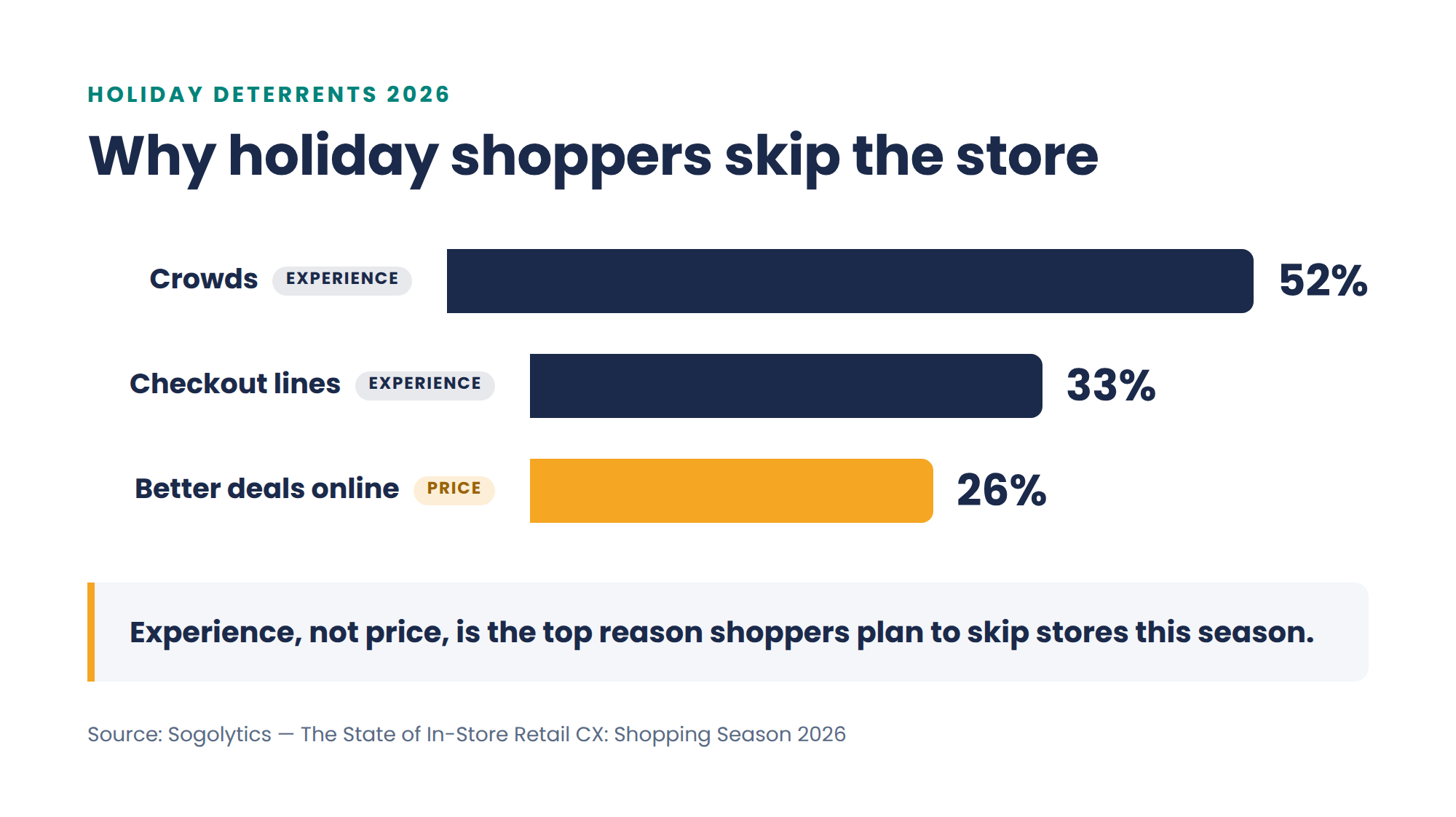
The holiday context raises the stakes further. Among shoppers who planned to skip in-store shopping this season, 52% pointed to crowds and 33% to checkout lines, while only 26% named better deals online. Friction in and around checkout outweighed price as the reason people stayed away. The lesson transfers cleanly to the digital equivalent, where a slow, unclear, or uneasy payment step produces the same result as a line out the door.
Four Ways to Make Trust Visible Before the Busiest Days
Trust responds to a short list of deliberate moves, and most of them can be in place before the season peaks.
1. Put the safety signals where the anxiety lives
Payment logos, a recognizable security cue, and a plain note on data handling belong beside the card fields, not buried in the footer. Baymard’s testing found that shoppers look hardest for reassurance at the payment step, so that is where it has to appear. A first-time holiday buyer should not have to hunt for evidence that their information is protected.
2. Strip the payment process to what you need
Cut redundant fields, stop asking twice for the same detail, and offer guest checkout and digital wallets so returning shoppers are not stranded behind a password wall. Every field you remove is one fewer reason to pause, and on a high-traffic day speed reads as competence.
3. Tune fraud rules with the customer in view
Track how often legitimate orders are declined, and watch the holiday patterns most likely to trip a strict system. When a decline does happen, give the shopper a clear path forward instead of a dead end, so an honest buyer has a way back in rather than a reason to leave for good.
4. Carry the promise past the payment
Extend the confidence you built at checkout into the delivery. A confirmation that sets clear expectations, and packaging that signals care and authenticity, tells the customer you meant what the site said. This after-sale window is easy to neglect when all the attention goes to closing the sale, and it is where a good experience either holds or unravels.
Turning Trust into Something You Can Measure
Trust feels abstract until you ask about it at the right moments, and then it becomes a metric you can move. A Customer Effort Score at the payment stage shows how hard the checkout felt. A satisfaction check tied to login reveals whether authentication helped or frustrated. A short confidence question at checkout captures whether the payment step built trust or drained it. And for declined payments, a brief survey to the shoppers you can still reach shows whether the block felt fair, which is the feedback that lets you calibrate fraud thresholds without guessing. Matching each measure to its moment keeps the readings honest and points to the specific fix that will move conversion.
What this Means for the Season Ahead
The gaps in this piece, the bare payment page, the overbuilt checkout, the stubborn login, the wrongful decline, and the forgettable delivery, share one trait: each is fixable, and each grows more expensive in the weeks when traffic is highest. The shopper arrives having already done the hard part. Whether that readiness becomes a completed order comes down to how safe the whole path feels.
For a retail organization, typically an omnichannel seller working across ecommerce, payments, fulfillment, and in-store operations, with the goal of turning seasonal visits into repeat customers, Sogolytics’ Experience Navigator works as a diagnostic framework rather than a quick fix. It maps trust and security touchpoints across the full journey, from the payment page and authentication through fraud handling to the box on the doorstep and ties each specific pain point to the right way to gather feedback. That structure lets a team see the whole arc at once instead of judging each screen in isolation, so a trust gap surfaces before it turns into lost revenue.
None of this requires rebuilding the store or overhauling the checkout. The opportunity is to make the payment experience feel clear, secure, and easy to complete. Start with the payment screen: make security cues and the final price easy to understand, and give legitimate shoppers who get declined a clear path to try again. These are small changes, but during the rush to Black Friday, they can make the difference between a completed purchase and an abandoned cart.
Trust at checkout is the shopper’s belief that a store is safe to buy from at the moment they enter payment details. It is shaped less by the actual security software and more by what the customer can see and feel: visible safety signals, a simple payment flow, a clear final price, and a login that works. During the holiday season, when many buyers are new to the brand, that perception often decides whether the sale is finished or abandoned.
Shoppers usually leave when the payment moment raises doubt rather than settling it. Common triggers include a payment page with no visible security signals, a checkout that asks for the same information twice, an unclear error after they hit pay, or a total that is higher than expected. Each one adds effort and worry at the exact point the customer wants to be done. On a busy day like Black Friday, that hesitation is enough to send them to a store that feels safer.
Pricing is a trust signal, not just a number. In The State of In-Store Retail CX: Shopping Season 2026, only 50% of shoppers who found the final price unclear said they would likely return, compared with 90% of those who found it clear, a 40-point swing. Confusing promotions mattered less, with a 31-point gap. The takeaway is simple: a shopper can forgive a fuzzy deal earlier on, but confusion about what they will pay at the register does lasting damage.
Yes. Fraud tools protect revenue, but tuned too tightly they decline legitimate customers, who often feel accused rather than merely inconvenienced. Holiday shopping raises the risk, because gift shipping, new addresses, and higher spend all look unusual to a strict system. The fix is not to switch fraud protection off. It is to review how often good orders get declined, give a clear next step when a decline happens, and use feedback to set thresholds that stop fraud without turning away honest buyers.
Trust becomes measurable when you ask about it at the right moments. A Customer Effort Score at the payment stage shows how hard checkout felt. CSAT tied to login reveals whether authentication helped or frustrated. A short confidence question at checkout captures whether the payment step built or drained trust, and a post-decline survey shows whether a fraud block felt fair. Matching each metric to the moment keeps the readings honest and points to the specific fix that will move conversion.
The Experience Navigator is a diagnostic framework rather than a switch to flip. It maps trust and security touchpoints across the full journey, from the payment page and authentication to fraud handling and physical delivery, and ties each pain point to a targeted feedback approach. That lets a retail team see the whole path at once, instead of judging each screen alone, so a trust gap becomes visible before it shows up in lost sales. It gives ecommerce, payments, and CX teams a shared view of where confidence is slipping.