




School choice keeps expanding. Since 2021, 18 states have adopted universal or near-universal choice programs, and another 16 have passed more limited versions. At the same time, pandemic relief money is drying up, and state and local budgets are tightening. We surveyed 534 families with K-12 students across the country and asked what shapes their decision to stay or withdraw their students from their current school district. We found that overall families in their assigned/zoned public school district are less likely to look for other schooling options compared to other school types. Moreover, families’ decisions to stay or leave a district were more strongly tied to relational factors that academic quality.


Public Districts are Not Losing the Retention Battle
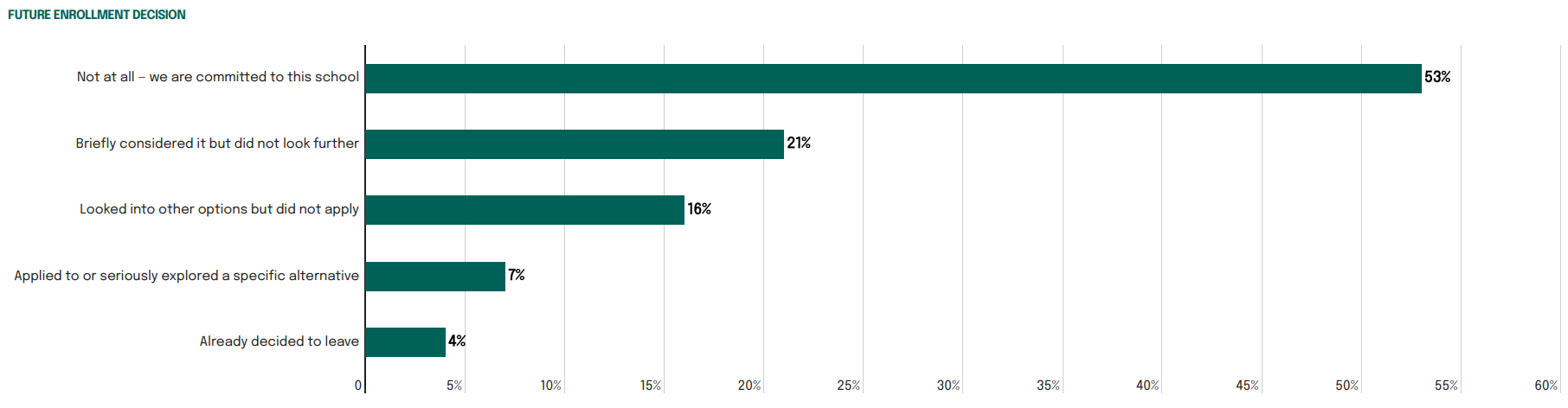
When we asked families how seriously they considered enrolling their child somewhere new in the past year, 53% said they had not looked at all. Among families in their assigned public district, that figure climbs to 63%, roughly 20 points higher than any other school type.
Only 6% of assigned public district families fall into the at-risk band, meaning they either applied to an alternative or already decided to leave. That is the lowest at-risk share in the study.
The real work is spotting the smaller wavering group early, before consideration hardens into a decision.
What Gets Families in the Door Is Not What Keeps Them There
When we asked about the top factors behind the original enrollment choice, convenience and flexibility came first at 51%, followed by academic reputation at 35% and cost at 34%. Safety and simply being the assigned school rounded out the top 5 list.
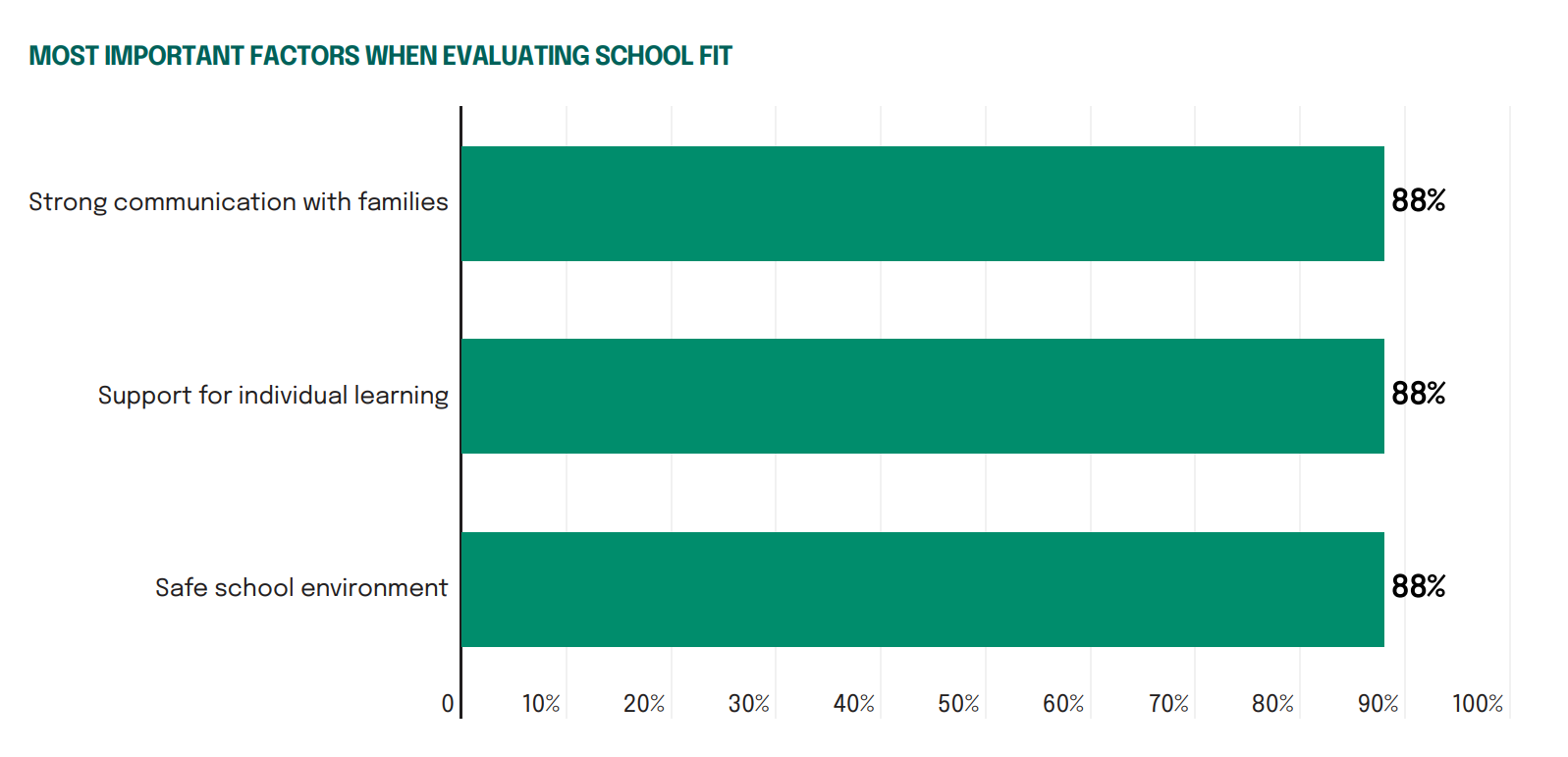
That goes to show how families choose a school, but not why they stay. Because when we asked what matters most in judging whether a school is the right fit, a safe environment, support for individual learning, and strong communication each mattered to 88% of families. Among these top three, safety was the top priority, with 68% saying it was very important.
Here is the practical version. Convenience and academics get a family through the door. Safety, communication, and individual learning support are what keeps them from walking back out.
Academics will and should always be a Districts first priority but results reinforce the importance of strong safety and communication practices. When families feel unheard or unsafe, the academic gains a district that works hard to produce can go unnoticed.
What Makes Families Look Is Not What Makes Them Leave
The reasons families start looking around are not the same reasons they finally leave.
Among families exploring other options, the top drivers were concerned about academic quality (32%), class sizes (29%), safety (27%), and school climate or bullying (27%). No single reason dominates and taken together; relational factors outweigh academic ones.
Among families who already decided to leave, the top reasons were situational: a specific incident at school (42%), concerns about school climate (37%), and family relocation (32%). Wavering academic quality may make a family start looking. A negative perception of school climate, or a negative incident at school, is what pushes them out the door.
Some Families Are Already Shopping for the Exits
Families whose children are in English Language Learner programs were the most likely to be looking elsewhere. Only 28% said they were not considering another school at all, the lowest of any subgroup, and 15% had already applied to or chosen an alternative.

The likely reason sits in how these families view leadership. One in five ELL families disagreed that school leadership makes decisions in the best interest of all students, far more than any other group.
The fix starts with establishing consistent and transparent feedback loops. That means providing opportunities for family input and communicating back in a language and format that is accessible to them. The same principle applies to any subgroup that feels overlooked.
Why The School Choice Threat is Smaller Than it Looks, For Now
In states with universal choice, only 36% of families said public funding had meaningfully expanded their options. Nearly half said their family does not receive public funding at all.
Even among families considering another district, 87% are exploring options that do not require opting into a private or religious school. 39% considered another public district, 29% homeschool, 25% online schooling, 16% private-religious schools, and 14% private non-religious schools.
Choosing a voucher is a deliberate and often time-consuming decision, and most families in choice states have not taken advantage of these options yet. That gives districts time to strengthen retention weak spots before more families do.
What This Means for Your District
Retention is the daily work of matching district investment to what families care about most. A few priorities stand out from the data.
- Watch the small wavering group rather than the committed majority, since even a few departures carry outsized budget impact.
- Continue to strengthen and increase transparency around safety and communication, which are already core to most districts.
- Close the feedback loop. Acting on family input, and showing families what changed after they spoke up, is the more novel move and the one this data points to most clearly.
- Pay closer attention to subgroups, like ELL families, where trust runs thinnest.
None of this requires a large budget. The things families most want more of, being heard and seeing their input led to change, are also the things a district can improve quickly and at low cost. The districts that treat climate, communication, and responsiveness as central work, and that measure whether their efforts are landing, are the ones that will hold their enrollment and their community trust as the education landscape keeps shifting.
Convenience and flexibility topped the list at 51%, followed by academic reputation (35%) and cost (34%). But when families judge whether a school is the right long-term fit, safety, support for individual learning, and strong communication each mattered to 88%. Practical factors bring families in; safety, individual support, and communication keep them.
87% of families who are considering another school district are exploring options that do not require opting into a private or religious school. Overall, 39% considered another public district, 29% considered homeschool, 25% considered online schooling, 16% considered private-religious schools, and 14% considered private non-religious schools.
Families who explore other options tend to cite academic quality, class sizes, safety, and school climate. But families who decide to leave point to situational reasons: a specific incident at school (42%), concerns about school climate (37%), or family relocation (32%). Relational and climate factors push families out more often than academics alone.
Not yet, in most cases. In universal choice states, only 36% of families said public funding expanded their options, and nearly half do not receive public funding at all. Policy has moved faster than family behavior, giving districts a window to strengthen retention weak spots.
Focus on the wavering group rather than the committed majority, , and close the feedback loop by telling families what changed after they spoke up. The survey shows engagement without follow-through can speed up departures instead of preventing them.
Every family in the survey who decided to leave had first given the school input, compared with 79% of families who stayed. The families heading for the exit were also more likely to feel their input was ignored. Acting on feedback, and showing families you acted, is where trust is built or lost.