





A First Look at the Q2 2026 Sogolytics Customer Experience Index
Customer experience research tends to confirm what brands already suspect. Customers want speed. They care about price. They are cautious about AI. The Q2 2026 Sogolytics Customer Experience Index does confirm some of that. But it also surfaces findings that cut against expectation, and those are the ones worth paying attention to.

Closing the Feedback Loop is Working. But it Comes with a Catch.
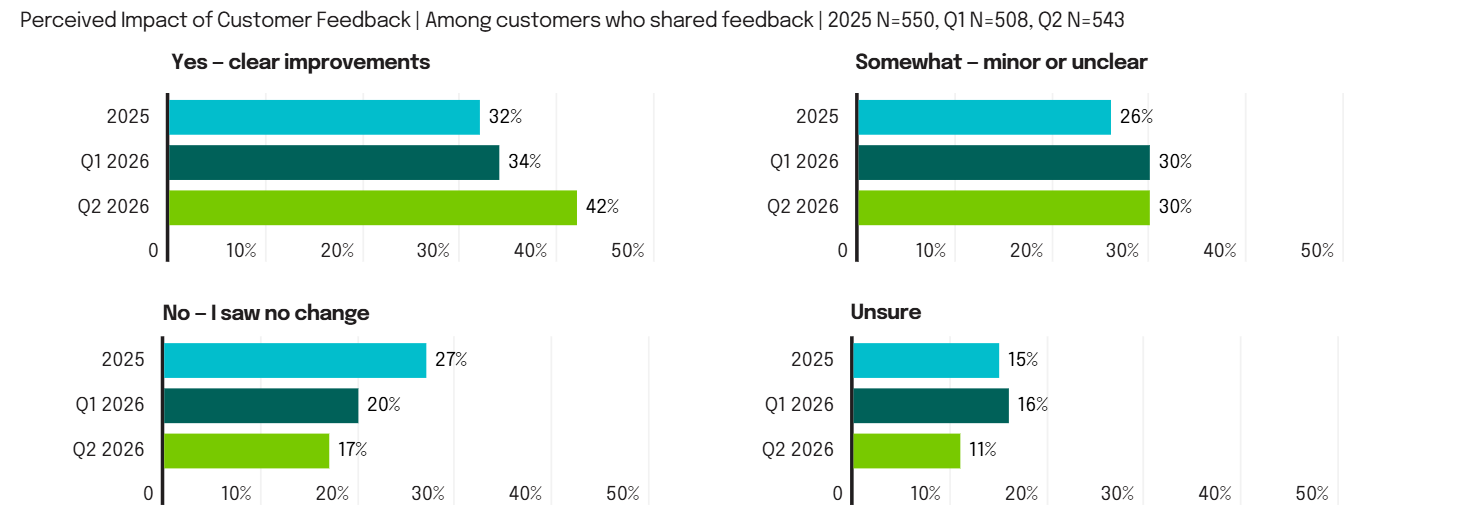
42% of customers in Q2 say their feedback led to clear, visible improvements. That is the highest figure recorded across all three editions of this study, up from 32% in 2025. Companies are genuinely getting better at listening and responding.
The catch: customers whose feedback led to improvements are more likely to switch after a bad experience than those who saw no change, 52% compared to 34%. Being heard raises expectations. Customers who know a company can respond well are less forgiving when it does not.
The Loyal Middle is Shrinking Fast
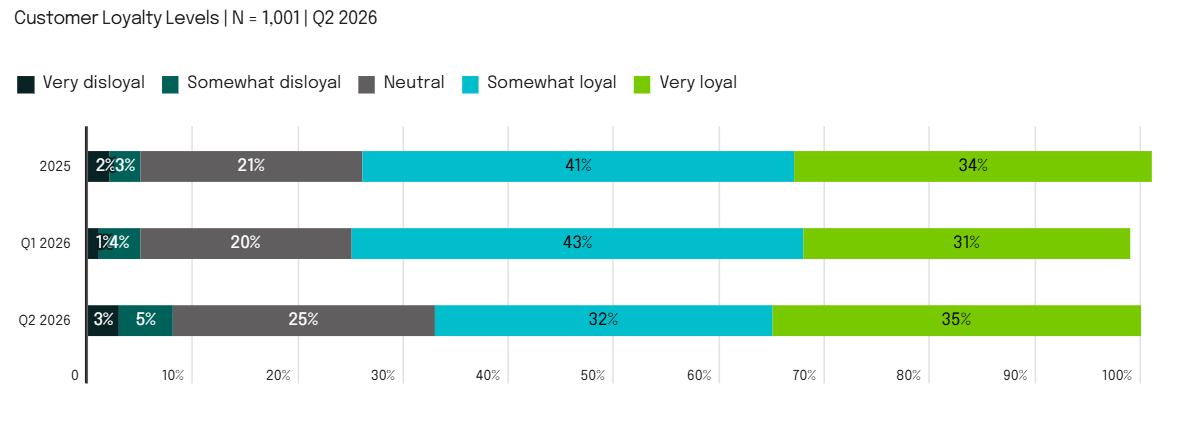
The “somewhat loyal” customer, not fully committed but reliably returning, fell from 43% in Q1 to 32% in Q2. That is an 11-point drop in a single quarter. At the same time, “very loyal” customers recovered to 35% and the neutral group grew to 25%.
Loyalty is polarizing. Customers are moving toward conviction in both directions, and fewer are settling in the middle. For brands, that middle was always the low-maintenance majority. Its disappearance changes the retention equation considerably.
Privacy is Now the Top AI Concern and that is a Shift Worth Noting
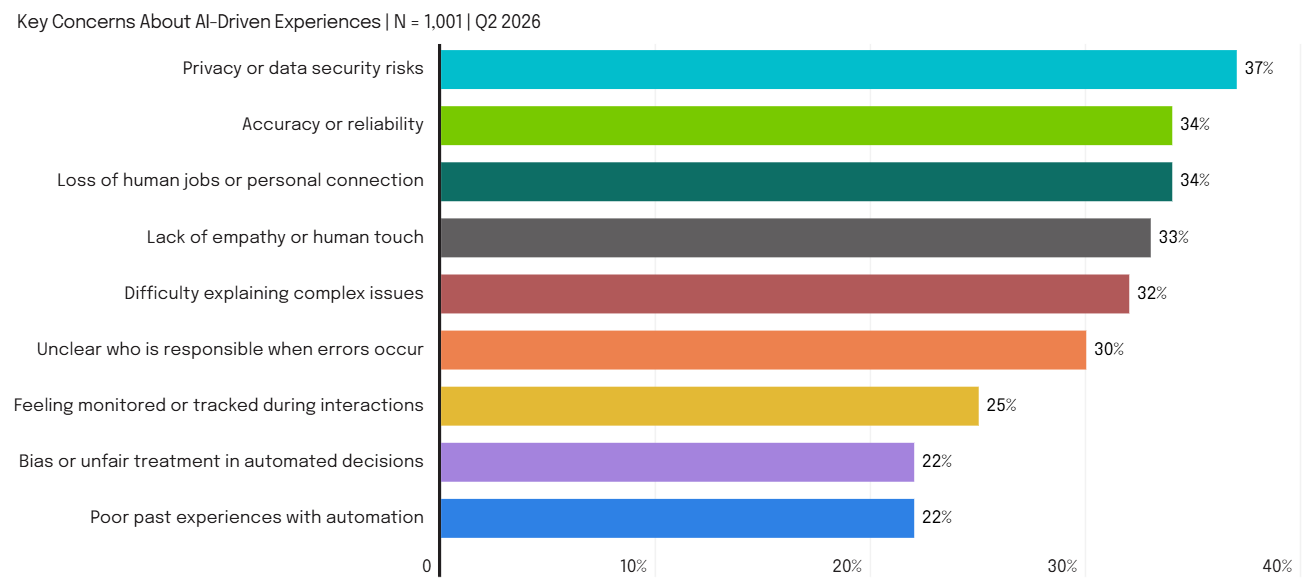
Privacy has overtaken accuracy as the top concern about AI in customer experience, with privacy cited by 37% of customers in Q2 while accuracy fell to 34%.
Customers are no longer primarily asking whether AI gets the right answer. They are asking what it knows about them and what is done with that information. That is a more sophisticated question, and it points to a different kind of challenge for brands deploying AI at scale.
Reading the Room
Customers are forming clearer opinions about AI. Loyalty is concentrating at the extremes. Feedback is being heard more than ever, and it is raising the bar rather than lowering it. The brands that hold ground are not the ones delivering the occasional standout moment. They are the ones consistent enough that customers stop noticing, in the best possible way.
The harder part of all this is not understanding what customers want. It is tracking how those wants shift, quietly and consistently, until the patterns are impossible to ignore. Loyalty does not collapse overnight. Trust does not erode in a single interaction. The signals are always there before the problem is. The question is whether anyone is paying close enough attention to catch them.
The Sogolytics Customer Experience Index is a recurring cross-industry study that tracks how consumers feel about the brands they interact with. Each edition measures loyalty, feedback impact, and attitudes toward emerging technology like AI. The Q2 2026 edition is the third release in the series, which lets us compare shifts quarter over quarter rather than relying on a single snapshot. That longitudinal view is what surfaces the changes brands tend to miss, since most consumer sentiment moves gradually rather than all at once.
Not on its own. Q2 2026 data shows 42% of consumers now say their feedback led to visible improvements, the highest across all three editions. The unexpected part is what follows. Consumers who saw their feedback acted on were more likely to switch after a poor experience, 52% compared to 34% among those who saw no change. Acting on feedback raises expectations, so the loop only protects loyalty when a brand can sustain the standard it sets. Inconsistency after listening well carries a steeper penalty than never listening at all.
Loyalty is concentrating at the extremes. The “somewhat loyal” group, consumers who returned reliably without strong commitment, fell from 43% in Q1 2026 to 32% in Q2, an 11-point drop in one quarter. Over the same period, “very loyal” consumers rose to 35% and the neutral group grew to 25%. The low-maintenance middle that brands long relied on is thinning. Retention strategy now has to account for customers moving decisively toward or away from a brand, rather than a stable majority quietly renewing out of habit.
In Q2 2026, privacy and data security overtook accuracy as the leading concern about AI in customer experience, cited by 37% of consumers versus 34% for accuracy. The question consumers ask has shifted from whether AI gives the right answer to what it knows about them and how that information is used. For brands deploying AI at scale, this reframes the challenge. Trust now depends as much on data handling and transparency as on model accuracy, and the two need to be communicated together.
The Sogolytics CX Index follows a quarterly cadence, with each edition building on the last. The 2026 series now spans a 2025 baseline, Q1 2026, and Q2 2026, which is what allows for direct quarter-over-quarter comparison. This rhythm matters because consumer sentiment rarely changes in a single dramatic move. Loyalty erodes and trust builds over consecutive periods, so a repeated measure catches the direction of travel earlier than an annual study would. It gives teams a reliable early signal rather than a once-a-year verdict.
Treat the findings of The Sogolytics CX Q2 Index as direction rather than a scorecard. The shifts that matter most this quarter are a feedback loop that raises expectations, loyalty polarizing toward both extremes, and privacy becoming the primary AI concern. Each points to consistency and transparency over occasional standout moments. A practical first step is auditing where your brand promises responsiveness, then confirming it can deliver that standard every time. The Experience Navigator can help map these priorities to your specific industry and objectives before you commit resources.