




The concept of listening to customers and employees is not new. Running surveys, tracking scores, and sharing brightly colored dashboards can suggest an organization is listening, but those that are just collecting feedback are missing the point.
If you’re watching customers exit, employees resign, or families find different educational options for their children, chances are their notice was in that feedback. For many of them, having that feedback ignored was the last straw.
A recent Sogolytics survey of 534 U.S. families with children in K-12 schools shows this pattern clearly. These specific findings are about schools, but the lesson can benefit any organization that relies on trust and repeat relationships.
Public Districts Have Competition
As opportunities for alternate modes and spaces of education continue to grow, districts are coming face to face with a problem that has previously been viewed as one reserved for the private sector – competition. Families now have the opportunity to educate their children through virtual programs, charter schools, school choice programs, and homeschool, making family satisfaction a growing priority for district leaders.
In the survey, only 27% of families said they enrolled their child in their current school because it was the default or assigned school. Among those considering leaving their current educational setting, participants most frequently said they were considering another school district (39%).
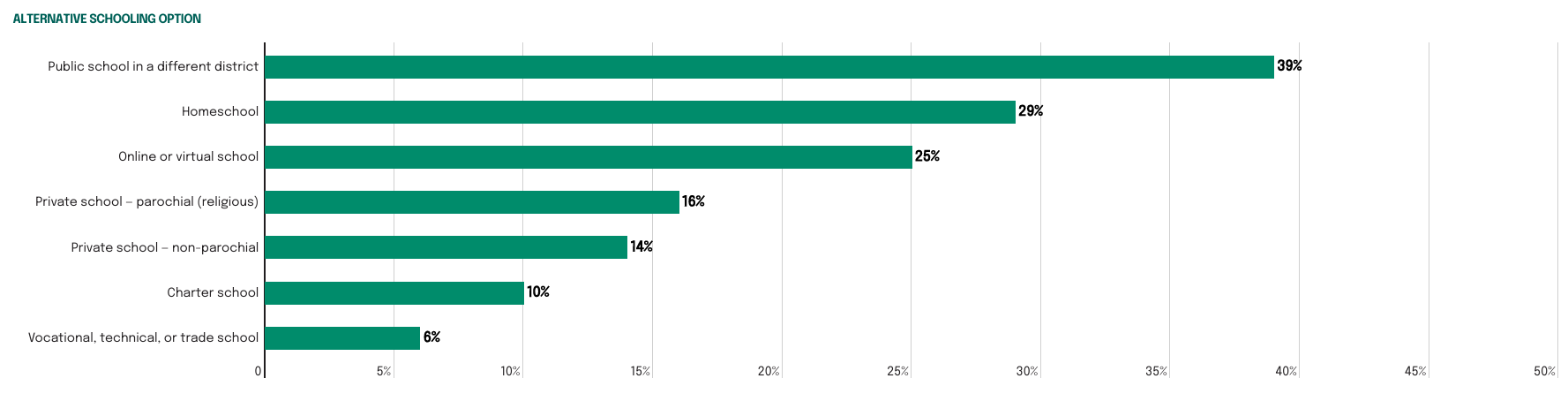
These findings display that while the traditionally assigned school does not automatically hold families due to their default assignment there, families are still loyal to the public school system. The experience they receive there can shape how far that loyalty goes.
Retention is a Relationship, not a Report Card
When families ranked what matters most when evaluating a school, the top answers indicate where loyalty can be lost. A safe environment, support for individual learning, and strong communication with families each landed as important to 88% of families. Safety alone was rated very important by 68%.
Trust in school and district leadership and responsiveness to family input were viewed as important by 87% of families. While many districts place the bulk of their focus on academics, these findings indicate loyalty is more about the relationships built between the district and families as their students engage in those academics. Districts often pour money into curriculum and test scores because those numbers show up in state rankings. Families, meanwhile, are watching whether the school feels safe, whether their child is nurtured, and whether anyone answers when they reach out.
The same gap shows up in business every day. Companies invest heavily in the product and underinvest in the relationship around it. Then they are surprised when a strong offering loses to a competitor that simply feels easier to trust. The notion of relationships as a major driver of loyalty spans all sectors. When strong communication, trust, and responsiveness are viewed as more important than the product (in this case, academics), it’s time to prioritize feedback and what’s being done with it once it’s collected.
The Feedback Paradox
Fortunately, the study showed that districts have ample opportunity to identify and address the concerns of families who seriously consider leaving before they walk out the door. In the past year, 79% of families committed to their current school had given their school some form of input. Among families who had already decided to leave, that number was 100%. Every single departing family had spoken up first, through a survey, an email, a board meeting, or a conversation with a teacher. Whereas many organizations are left wondering why their customers left, school districts have an advantage – those leaving are sharing feedback before they do so.
The report points to the critical error made by districts. The share of families who felt the school had not acted on their input rose from 19% among committed families to 26% among those who decided to leave. People did not leave Quietly; they left because they spoke, watched nothing happen, and drew the obvious conclusion that their engagement was not valued.
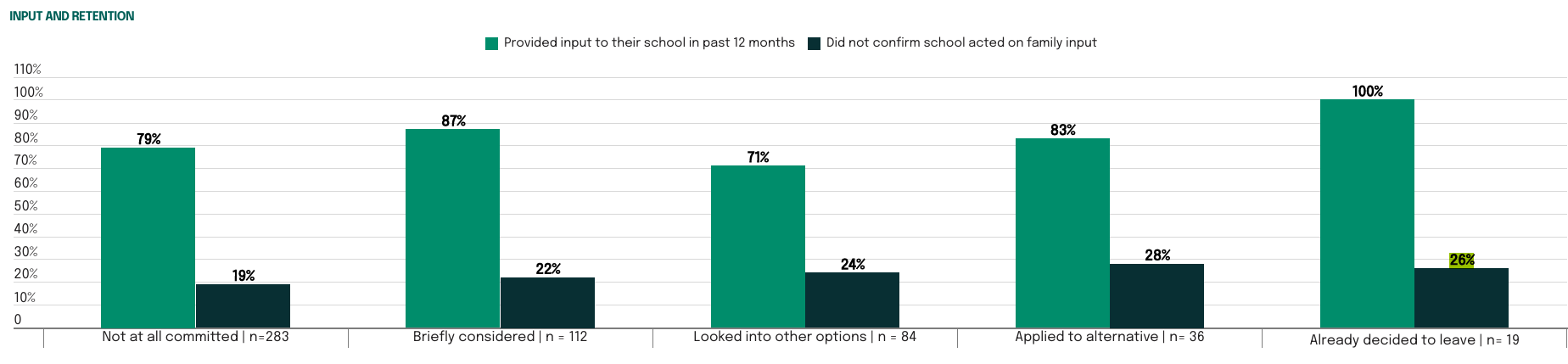
This is the feedback paradox: asking for input creates a promise to close the loop and do something with the feedback. When you break that promise, you do more damage than if you had never asked at all. As the study puts it plainly, requesting feedback without follow-through does not build commitment; it speeds up the exit.
You Can Only Act on the Voices You Hear
Simply responding to collected feedback may not be enough; if you aren’t hearing from 100% of your customers, response bias could send you down action plans that don’t serve your full base.
The survey found that families of English language learners were the most likely to be looking for an exit. Only 28% said they were not considering another school, the lowest of any group. One in five disagreed that school leadership makes decisions in the best interest of all students, far above the 6% to 13% seen elsewhere.
This response bias can skew feedback, and in turn how you respond. The families least confident in leadership were often the families whose voices were hardest to capture in the first place. If your feedback only reaches people who share your language and your format, your data will always look better than your reality, and your response will never hit the mark for these families.
This is the exact problem Bryan Independent School District set out to fix.
What Closing the Loop Looked Like in One Texas District
Bryan ISD serves about 15,600 students across 23 campuses in Texas. A significant portion of the community is Hispanic, and roughly 30% of students are emergent bilingual learners. For years, the district had a listening problem it could not see.
Surveys ran on scattered tools like SurveyMonkey, campus by campus. The results could not be combined or compared. Worse, Spanish-speaking families, close to a third of the community, had no way to give feedback in their own language. Their signal was omitted from every report leaders read.
The district moved all of its feedback onto one platform and built its surveys in both English and Spanish. In-house translators worked in a familiar spreadsheet format and uploaded directly. Distribution went out through QR codes, email, ParentsSquare, and social media, with informed reminders that ran automatically.
The results of these shifts showed up fast. Staff survey response grew by 50% in a single cycle, from about 1,000 to 1,500. More importantly, families who had never been counted were finally included in the data.
They then engaged in a task most organizations bypass once they can say feedback was collected. Bryan ISD used comparative reporting to line up how students, teachers, parents, staff, and community members saw the same issues, and brought those reports straight to the Board of Trustees. When the district weighed a new hybrid virtual school program, it had real evidence of family and student interest to guide the call.
“The Sogolytics platform is very intuitive and easy to use, and I usually find what I need. It’s made my life easier,” said Dr. Jill Morris, Director of Accountability and Federal Programs at Bryan ISD. What changed was not the act of listening; Bryan ISD had been collecting family feedback for years. The shift was in who got heard, whether the answers could be compared, and how leaders acted on the results. Check the Complete Case Study.
Three Principles for Any Leader Who Runs on Trust
The Bryan story and the national data point to the same set of habits. They apply to a superintendent, a hospital administrator, and a head of customer experience in equal measure.
1. Treat every request for feedback as a promise
If you ask, people expect a response. The safest move is not to stop asking. It is to always report back on what you heard and what you changed.
2. Design for the voices you are missing
Look hard at who never shows up in your data. Language, format, timing, and access all decide whose experience gets counted and where you’re letting response bias steal your customers’ voice. The groups hardest to reach are often the ones closest to leaving.
3. Close the loop out loud
Collecting input is step one and the easy part. Telling people what you did with it, including what you could not do and why, is what turns a survey into a relationship.
The Discipline that Keeps People
The instinct to listen more is a good one. But listening without a response is not a neutral act. It builds expectation, and broken expectation damages loyalty. The families most likely to leave a school gave the clearest warnings and the most chances to keep them. The same is true of your best customers and your strongest employees.
The organizations that hold on to people are not the ones running the most surveys. They are the ones that hear everyone, compare what they hear, and prove they acted. That is not a technology problem. It is a leadership discipline, and it is one any leader can start practicing this quarter.
“I would be curious to hear from other leaders. When was the last time you told your people what really changed because of their feedback?” Dr. Kate Popham is Director of Research and Advisory Services at Sogolytics, where she studies how feedback shapes trust, retention, and decision-making across K-12 districts and beyond.
It is the pattern where the people who engage most with an organization are also among the most likely to leave. In the Sogolytics K-12 survey, 100% of families who decided to leave had given input first, compared with 79% of families who stayed. Asking for feedback and then not acting on it can push people away faster than never asking.
Because engagement creates an expectation. When people speak up and see no response, they read the silence as an answer. In the survey, the share of families who felt their school ignored their input rose from 19% among committed families to 26% among those who chose to leave.
It means telling people what you heard, what you changed, and being transparent about what you could not change and why. Collecting responses is only the first step. Closing the loop is the part that turns a survey into a trusted relationship and helps retention.
The data suggests the panic is overstated. In the Sogolytics survey, 63% of families at their assigned public district were not considering another school at all, the strongest committed base of any school type, with only 6% at serious risk of leaving.
Start by looking at who is missing from your data. Language, format, and access often decide whose voice gets counted. Bryan ISD added Spanish-language surveys and multiple distribution channels, which helped bring previously unheard families into decision-making and grew staff response by 50%.
Bryan ISD moved from scattered survey tools to one platform, deployed surveys in English and Spanish, and used comparative reporting to align perceptions across students, teachers, parents, staff, and community for board-level decisions. Staff response grew 50% in a single cycle, from about 1,000 to 1,500.