Retail organizations are collecting more customer feedback than ever before. From post-purchase surveys, product reviews, NPS programs, social listening tools to customer service satisfaction scores, and the signals are everywhere. Yet, most retail teams will tell you that turning those signals into meaningful operational improvements remains one of their biggest challenges.
The problem is not a shortage of data. It is the absence of a system for connecting feedback to the specific moments in the customer journey where it matters most.
Where Retail Feedback Programs Break Down
Consider how feedback typically flows through a retail organization:
- A product review tells you something about how a customer perceives an item after it arrives, but it does not explain why they almost abandoned their cart during checkout.
- A customer service satisfaction score captures how well an issue was resolved, but it misses the upstream experience of failure that created the support ticket in the first place.
- A site-wide NPS number gives you a general sentiment reading, but it cannot tell you whether your biggest opportunity lies in improving search relevance, simplifying returns, or fixing mobile load times.
Each of these feedback channels captures a piece of the picture. None of them, on their own, provides the full view a retail leader needs to make confident investment decisions about where to focus on improvement efforts.
The core challenge: Retail teams collect feedback across dozens of touchpoints but lack a structured way to connect those signals to specific moments in the customer journey and translate them into prioritized action.
The Cost of Fragmented CX Insights
When feedback stays siloed by channel or department, several things happen. Teams optimize their own metrics without seeing how those metrics interact. The digital team improves page load speed while the fulfillment team struggles with tracking transparency, and neither team understands which improvement would move overall customer satisfaction further.
Marketing invests in personalization, but the recommendation engine surfaces products customers have already purchased. Support handles growing ticket volume without visibility into the experience breakdowns generating those tickets.
| Feedback type | What it captures | What it misses |
|---|---|---|
| Product reviews | Post-delivery product perception | Pre-purchase journey friction, checkout experience |
| NPS surveys | Overall brand sentiment | Specific touchpoint breakdowns, root causes |
| CSAT (support) | Resolution quality | Upstream failures that triggered the support need |
| Cart abandonment data | Where customers leave | Why they leave, what would bring them back |
The result is a reactive approach to experience management. Teams respond to the loudest complaints rather than the most impactful opportunities. Resources get allocated based on intuition rather than evidence.
A Framework that Connects Feedback to Action
Closing this gap requires a structured approach that breaks the retail journey into defined touchpoints across multiple categories: digital interactions, physical fulfillment and packaging experiences, operational processes, and human support interactions. Each touchpoint needs to be evaluated for specific pain points, paired with targeted feedback methods, and measured against metrics that connect directly to customer outcomes.
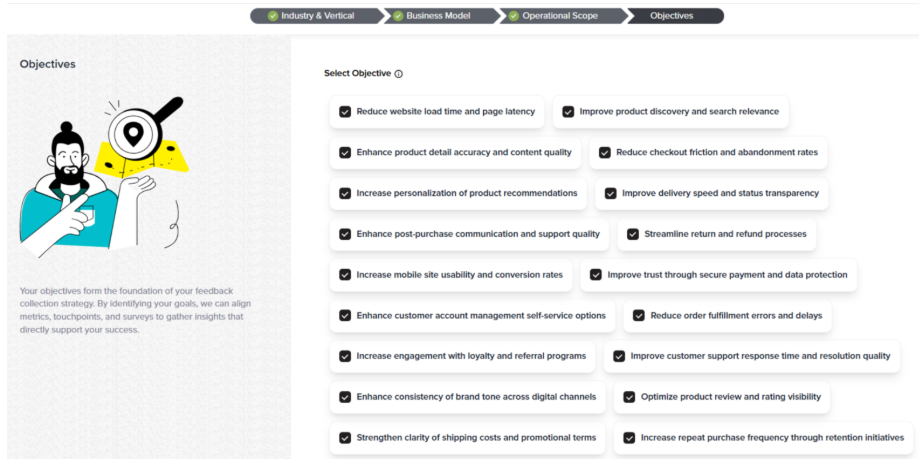
The Experience Navigator identifies specific objectives across the retail customer journey, from website performance to loyalty program engagement.
This kind of structured framework accomplishes several things. It creates a shared map of the customer journey that aligns teams around a common understanding of where experience breakdowns occur. It provides a way to collect feedback specific enough to be actionable, moving beyond broad satisfaction scores to targeted questions tied to individual touchpoints. And it enables ongoing measurements that track whether improvements are working.
From General Customer Sentiment to Targeted Improvement
For retail operations that span multiple business models, from direct-to-consumer brands to multi-brand online retailers to omnichannel click-and-collect operations, this structured approach becomes especially valuable. Different models create different customer journeys, and a framework that can adapt to those differences while maintaining consistent measurement practices gives organizations the flexibility they need without losing strategic coherence.
That shift, from general sentiment tracking to structured, touchpoint-level experience management, is where the competitive advantage lives. The retailers who make it are the ones who stop treating feedback as a reporting exercise and start treating it as the foundation of a continuous improvement system.
If you are ready to see what that looks like in practice, the Sogolytics Experience Navigator is a good place to start. It walks you through how to map your specific retail journey, identify the touchpoints that matter most for your business model, and connect targeted feedback to measurable outcomes.