


Customer experience is no longer defined by a single interaction. It is shaped over time, across moments, channels, and expectations that continue to evolve.
Many organizations are still optimizing for individual touchpoints. Faster responses. Better interfaces. More personalization. And in many cases, they are succeeding. Customers report strong satisfaction with their most recent experiences. But that does not always translate into how they feel about a brand overall.
From Individual Interactions to Overall Perception
In the Q1 Sogolytics Experience Index: Customer Edition (CX) 2026, 39% of customers say they were very satisfied with their most recent experience, yet only 24% say the same about their overall experience with companies. This gap reflects a shift in how customers evaluate brands.
A single interaction, whether positive or negative, does not fully define perception. Customers are forming opinions over time, based on patterns, not moments. Consistency is becoming more important than isolated success.
What Customers Actually Value in a Great Experience
While expectations continue to rise, the definition of a great experience remains surprisingly consistent.
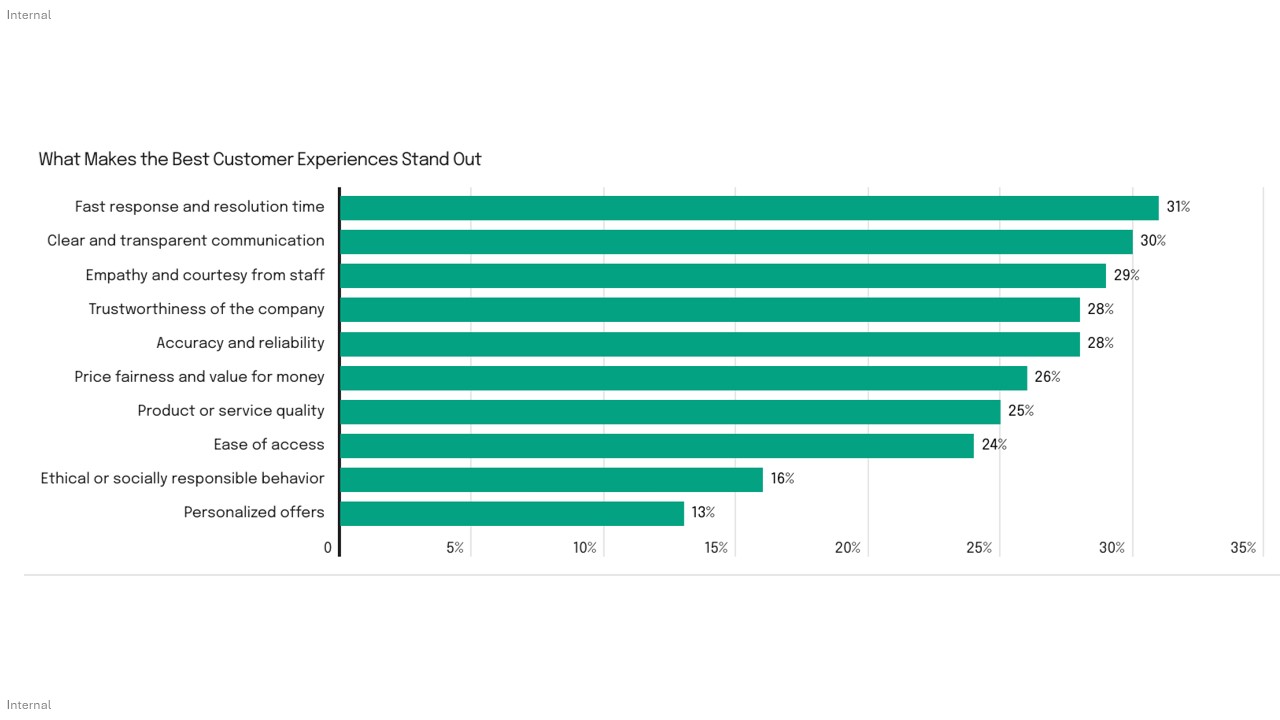
Source: Sogolytics, CX Q1 2026 Study
Findings from the Sogolytics study show that fast resolution, clear communication, and empathy are the most important drivers of a strong experience. These are not new expectations, but they are becoming less forgiving. When these fundamentals are missing, the impact on perception is immediate.
This creates a clear challenge. Companies are investing in new capabilities, but customers are still judging experiences based on how well the basics are delivered.


Rising Expectations, Narrower Margins for Error
At the same time, expectations are increasing. More customers now say their expectations are higher than they were five years ago, and that shift is shaping how everyday interactions are perceived.
What once felt fast now feels average. What once felt convenient is now expected. The baseline continues to move, often faster than companies can adapt. As a result, even small gaps between expectation and delivery are becoming more visible.
Trust Is Now Part of the Experience
Customer experience is no longer just about execution. It is also about trust.
Customers are more aware of how their data is used, how decisions are made, and how companies communicate. They are open to personalization and automation when it improves speed and convenience, but that openness comes with conditions. Transparency and clarity are no longer differentiators. They are expectations.
The Shift Toward Consistency
As expectations rise and experiences become more complex, loyalty is also changing. Customers are less tied to brands and more responsive to each interaction. A single negative experience can be enough to trigger switching behavior.
The implication is clear. Customer experience is no longer about delivering standout moments. It is about delivering consistent, reliable, and trustworthy experiences across every interaction.
Companies that focus on getting the fundamentals right, every time, will be better positioned to meet rising expectations and build stronger customer relationships in 2026.