



Why Gym Motivation Fades Faster Than We Think
A new member walks in during the first week of January. They arrive early, full of energy, ready to change their routine. For a few weeks, the motivation is strong. The workouts feel purposeful. The progress feels possible.
Then something shifts.
Work gets busy. The gym feels more crowded than expected. The routine becomes harder to maintain. Slowly, visits become less frequent until one day the habit disappears entirely.
This pattern is far more common than most people realize. A recent Sogolytics study, The Emotional Side of Gym Retention: Why Motivation Fades and Members Leave, based on responses from more than 1,000 U.S. adults, suggests that the challenge is not starting a fitness journey. It is sustaining it.
The Data Behind Gym Membership Churn and Retention
Nearly two thirds of respondents say they are likely to set fitness-related goals, and many believe they are making progress. But motivation often begins to weaken within the first few months. Among those who are new to exercise, 31% report losing motivation within the first few weeks of starting a routine. What begins as a commitment to change can quickly turn into a struggle to stay consistent.
This early drop in motivation highlights an important truth about fitness behavior. The decision to pursue a goal is often emotional. Maintaining that goal requires something more durable.
The Hidden Role of the Gym Environment
When people think about gym retention, practical factors like cost and location usually dominate the conversation. Those elements certainly matter. In fact, 39% of respondents say membership cost plays a major role in choosing a gym, while 35% cite location.
But the research reveals something deeper. The emotional experience inside the gym plays a powerful role in determining whether people keep showing up.
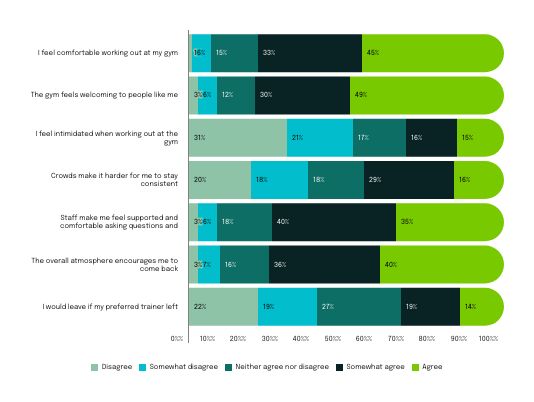
Most members report positive experiences. About 78% say they feel comfortable working out at their gym, and 79% say the environment feels welcoming. When gyms create spaces where people feel supported and confident, those environments reinforce consistency.
However, even subtle friction can undermine that sense of comfort.
Emotional Comfort Within the Gym Environment
Source: Sogolytics 2026 U.S. Gym Retention Survey
45% of respondents say crowds make it harder to stay consistent, and nearly one third say they sometimes feel intimidated while working out. These experiences may not immediately cause someone to cancel their membership, but they can gradually erode the desire to return.
Over time, that emotional friction matters.
Why People Leave Fitness Memberships
Gym cancellations rarely happen overnight. Instead, they tend to follow a slow buildup of practical and emotional barriers.
Cost remains the most frequently cited reason for leaving. Among people who cancelled a gym membership in the past year, 35% say the membership was simply too expensive.
But lifestyle changes and shifting habits also play a role. More than a quarter of former members say they switched to home workouts or online fitness platforms instead of continuing their gym membership.
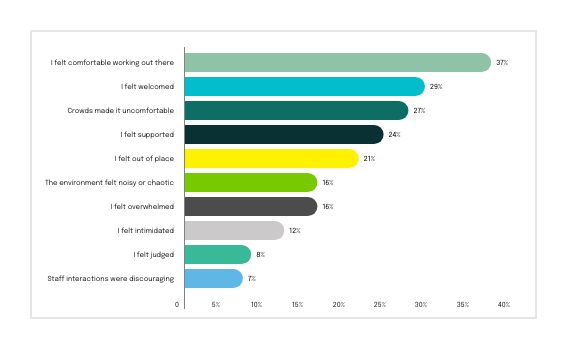
When participants described their experiences at the gym, another theme emerged. Some environments felt crowded, chaotic, or socially uncomfortable. About 27% say crowds made their gym environment uncomfortable, and others described feeling out of place or overwhelmed during busy hours.
Gym Retention Is an Emotional Problem
The findings suggest that gym retention is not simply an operational challenge. It is also an emotional one.
Fitness goals often begin with excitement and aspiration. But when motivation declines, the environment surrounding those goals becomes critical. A gym that feels welcoming, supportive, and manageable can reinforce habits even when motivation fluctuates. A space that feels crowded, intimidating, or impersonal can quietly weaken engagement.
How Members Say Their Previous Gym Felt
Source: Sogolytics 2026 U.S. Gym Retention Survey
Understanding these emotional signals is essential for gyms trying to retain members in an increasingly competitive fitness landscape.
For organizations looking to understand these dynamics more deeply, listening to member experiences is a powerful place to start. Tools that capture real time feedback and track changing sentiment can help fitness organizations identify early signals of disengagement before members decide to leave.
Because in the end, retention rarely breaks when someone cancels their membership. It begins to weaken much earlier.
The motivation data goes deeper. Discover what keeps members coming back, and what drives them away.