



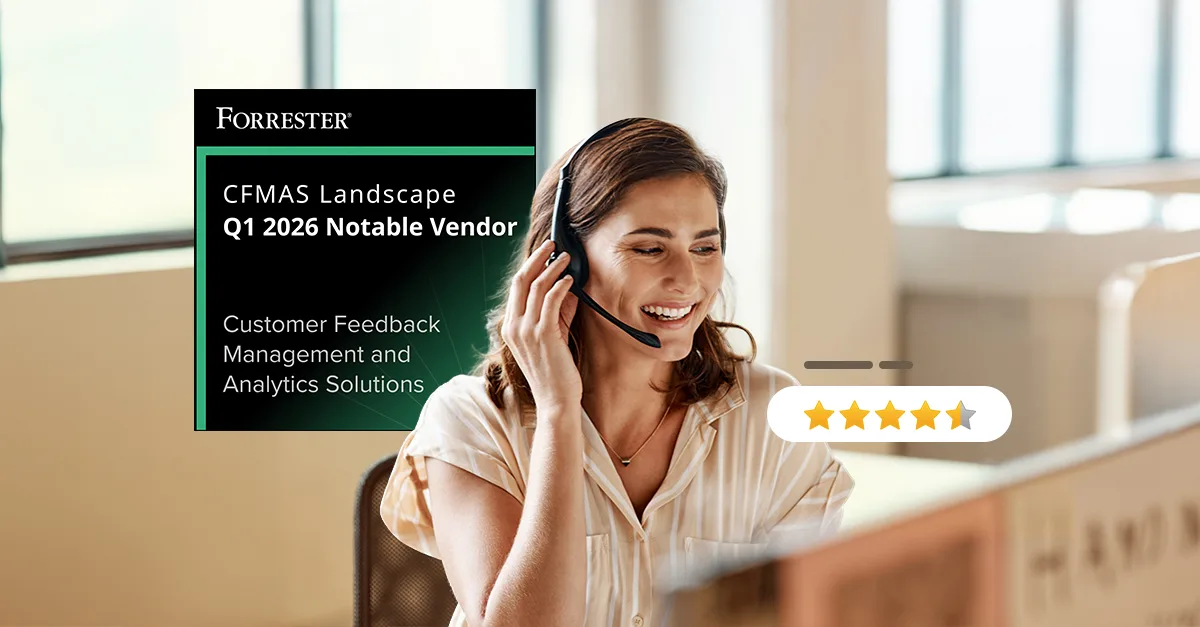
Sogolytics has been named among the notable vendors in Forrester’s Customer Feedback Management and Analytics Solutions Landscape, Q1 2026.
The recognition lands at a moment of real change in our category. Collecting customer feedback from every channel used to be the headline feature. Now it’s a baseline assumption. Buyers have absorbed that promise, and they’re asking a harder question: what happens after you listen?
That’s the question we’ve been building around. And it’s the question we think will separate the next generation of CX platforms from the last one.
Where we’re Focused, and Why?
When Forrester invited us to identify the top three areas of focus for our product and roadmap, we named three: closing the loop with customers, customer journey understanding, and measuring ROI of CX.
That wasn’t a marketing exercise. It reflects where we’ve been investing and what our customers have been telling us matters most.
Closing the loop is about making follow-through visible and systematic, not just responding to one frustrated customer. Journey understanding is about spotting where consistency breaks down across touchpoints before it compounds into churn. And ROI measurement is the piece that keeps CX investment funded, because without it, every budget cycle becomes a fight for survival.
One Great Interaction is Easy. Sustaining it is Where Most Teams Stall
Our own research backs this up. The Sogolytics Experience Index: Customer Edition 2026, a national survey of 1,011 U.S. adults, found that 40% of consumers were very satisfied with their most recent customer interaction. But when we asked about the quality of experiences they typically receive, only 24% said the same.
That 16-point gap tells you everything. Companies can nail a single moment. Delivering consistent quality across channels, touchpoints, and repeat interactions is a different problem entirely. It’s also the problem that journey understanding, as a capability area, is designed to address.
The consequences show up fast. Our research found that 33% of consumers are likely or very likely to switch to a competitor after a single negative experience. Loyalty in 2026 is conditional. It gets tested every time a customer reaches out and doesn’t get what they expected.

Customers don’t Believe their Feedback Changes Anything
Here’s a statistic from our CX Index that should concern every feedback program owner: only 32% of customers said their feedback led to clear improvements. Another 26% reported minor or unclear changes. And 27% saw no change at all.
That’s not just an operational gap, but a trust problem. Even when organizations act on feedback, customers don’t see it unless someone closes the loop and makes the improvement visible.
Manual follow-up doesn’t scale. What does scale is workflow automation that makes follow-through repeatable, trackable, and visible to the customer who gave you the input in the first place. It’s the reason closing the loop sits at the top of our focus list.
When customers see their input leading to tangible change, it reinforces the behavior the feedback program was designed to encourage. When they don’t, they stop giving you honest answers. Or they stop answering altogether.
Measuring ROI: The Conversation CX Teams Keep Avoiding
Most CX teams know they should measure ROI, but few can really show how feedback translates into revenue saved or costs avoided. Our CX research found that consumers overwhelmingly prioritize cost reduction (44%) and data protection (43%) as the area’s brands should focus on over the next decade. Only 16% ranked personalization as a top priority. That’s a sharp decline from the attention personalization received just a few years ago.
The message from customers is clear. They’re not asking for flashier experiences. They want fair pricing, trustworthy data handling, and consistent service.
CX leaders who can quantify how closing the loop reduces churn or how journey optimization lowers cost-to-serve are the ones who will keep their programs funded through the next budget cycle and beyond. The rest will spend the year defending line items.
What this Means for Your CX Platform Decision
Our category is in a real flux. Generative AI is compressing the gap between vendors on surface-level capabilities. M&A activity is redrawing category boundaries. And more organizations than ever are weighing whether to build feedback analytics capabilities in-house rather than buy them.
In that environment, the question isn’t which vendor has the longest feature list. It’s which vendor’s strategic focus aligns with where CX is headed. Omnichannel data collection is necessary, but no longer sufficient. What separates the next generation of CX platforms is the ability to close the loop at scale, understand journeys across their full arc, and tie experience improvements to measurable business outcomes.
That’s where we’re investing. And it’s what we think the inclusion in the Q1 2026 Landscape reflects. If those priorities align with yours, the next step is a conversation.