


The Difference Between Knowing Your Customer and Understanding Them
A few weeks ago, I took my car in for service. I had booked the appointment in the app, typed two sentences about a rattle in the front passenger door, and thought nothing more of it. When I walked in, the advisor greeted me by name, told me the diagnostics my car had already uploaded overnight, confirmed the technician had reviewed them that morning, and gave me a repair time before I had said anything beyond hello.
Nobody asked me to describe the problem. Nobody asked for my account number. The entire interaction was built on information I had already chosen to share, used exactly the way I would have wanted it to be used. It did not feel invasive. It felt like being expected.
That visit is the whole argument of this article in miniature. Because here is the tension in our cross-industry consumer research: 58% of people say personalized experiences matter to them, yet when we asked what companies should focus on over the next decade, personalization ranked dead last, behind data protection, cost, speed, and transparency.
Customers have not stopped wanting to feel understood. They have stopped rewarding brands that confuse “we have your data” with “we understand you.” Everyone has experienced the difference. An email that acknowledges the exact issue you called about last week feels helpful because it shows the brand is paying attention in a meaningful way. But a product ad that follows you across every website, even after you’ve already bought the product, does the opposite. It doesn’t demonstrate understanding. It simply reminds you that the brand is tracking your behavior without using that information in a way that improves your experience.
The stakes are not abstract. In the same research, 37% of consumers say they are likely to switch to a competitor after a single negative experience. A personalization program that gets the moment wrong is not neutral. It is actively spending down trust the brand cannot afford to lose.
The Conversation has Moved but Most Programs Have Not
Three forces pushed the industry past personalization at the same time.
1. Saturation
When every brand sends the tailored email and the retargeted ad, the tactic stops differentiating. A recommendation only lands when it is genuinely useful, not merely tailored.
2. Trust
Consumers have grown fluent in how their data gets used, and they price it into their loyalty. In our research, 46% say they would stop using a company that sold their data without consent, and 68% report being at least somewhat more loyal to brands that clearly explain their data practices. Customers reward transparency and penalize misuse quickly and in both directions.
3. Structural
As the ecosystem moves away from third-party signals, the brands with the richest consented understanding of their own customers hold the advantage. That understanding is not bought. It is earned, one interaction at a time, from the people you already serve.
That research spans industries rather than any single vertical, yet the lesson transfers everywhere: the era of personalization as decoration is over. What replaces it is relevance as a discipline.
Context-aware Personalization: From Knowing Who to Understanding When
Here is the reframe that matters for leaders:
Legacy personalization answers who a customer is. Context-aware personalization answers what situation they are in right now.
A customer’s name, tier, and purchase history are static facts. Three help-center visits about the same feature this morning, a low CSAT score last week, and a browser currently sitting on your pricing page are context. The first tells you about a person. The second tells you what to do in the next five minutes.
Context-aware personalization treats experience data as a live stream rather than a stored profile. It combines behavioral signals, stated feedback, and the moment itself to decide what is relevant now. Done well, it feels like good service. Done poorly, it feels like being watched. The difference is not the sophistication of the model. It is restraint, consent, and whether the relevance can be traced back to something the customer knowingly shared.
Six Capabilities, One Foundation
Hyper-personalization is not a feature you buy. It is a set of connected capabilities, and every one of them stands or falls on the quality of your first-party data.
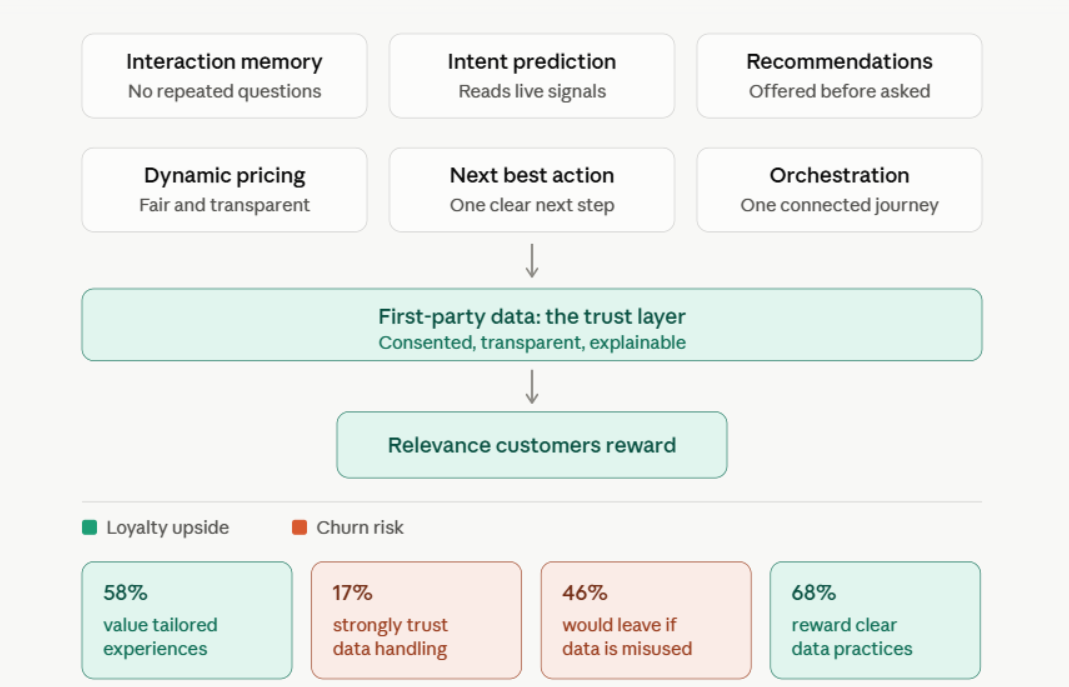
(Infographic above: production team can rebuild in brand palette. All four stats trace to the Experience Index; the trust-layer framing mirrors the article’s core argument.)
1. Interaction Memory
The simplest form of respect is not making a customer repeat themselves. When a member calls their credit union and the representative already sees last week’s unresolved issue, the relationship feels continuous. This requires feedback and interaction history to live in one place. Most organizations have the data. Few have it in the same room.
2. Intent Prediction
Customers signal what they need before they say it. A spike in support visits ahead of a renewal is a churn flag. Repeated browsing without buying is a confidence gap. Intent prediction reads the signals customers are already sending and answers the question before it is asked. Done right, it feels like anticipation. Done from thin data, it feels like a guess, because it is one.
3. Proactive Recommendations
The best recommendation is one the customer did not request and immediately recognizes as right. That only happens when it is grounded in their own history and stated preferences rather than a lookalike model. A recommendation that ignores what someone told you last month is not personalization. It is noise with a confidence problem.
4. Dynamic Pricing
Approach this one with the most care. Pricing that reflects loyalty, tenure, or a transparent offer strengthens a relationship. Pricing that feels arbitrary erodes it fast, and fair pricing consistently ranks among the strongest loyalty drivers in our research. The version worth building is transparent and value based. The version that quietly charges different people different amounts for the same thing is a trust liability dressed up as a growth lever.
5. Next Best Action
Infinite options paralyze frontline teams. The Next Best Action narrows everything you know about a customer down to the single step most likely to help them right now: a proactive call after a poor experience; a resource surfaced before the struggle starts. The value is not more insight, but it’s one clear decision.
6. Journey Orchestration
Individual moments matter less than whether they connect. Orchestration coordinates messages, offers, and service actions across channels, so the customer experiences one relationship instead of five departments. This is where most programs quietly fall apart, because the data that would connect the journey sits in tools that were never designed to talk to each other.
The Line Between Relevance and Intrusion
Every capability above sits on the same fault line. Relevance and intrusion are built from the same raw material. What separates them is not the model. It is whether the customer would recognize the data behind the moment as something they chose to share.
Our research is blunt on this. Only 17% of consumers strongly agree that they trust most companies to protect their personal data, while 43% strongly agree that companies should be more transparent about how they use it. Comfort with data use is rising, now at 42% and up ten points year over year, but it is conditional. Permission is extended to brands that earn it and revoked from brands that surprise them.
The working rule is simple enough to put on a wall: use data the customer knowingly shared, for purposes they would recognize as helpful, in ways you would be comfortable explaining to their face. Relevance a customer can trace back to something they told you feels like attentiveness. Relevance that arrives from nowhere feels like a breach, even when it is technically compliant.
This is why first-party data is not a technical preference. It is the trust layer. Data gathered directly, with consent and a clear purpose, is the only foundation that lets a brand get more personal without getting more invasive.
Where the Feedback Loop Comes in
Here is the part most personalization conversations skip: the richest first-party data a company owns is what customers tell it directly. Behavioral data shows what people do. Feedback shows why. Hyper-personalization built on behavior alone is educated guessing. Built on behavior plus stated experience, it becomes understanding.
That is the gap SogoCX closes. Continuous voice-of-customer listening captures what customers actually say across touchpoints instead of once a year. Journey analytics show where relevance is landing and where it is misfiring. Connecting operational behavior with stated sentiment gives intent predictions and next best actions something real to stand on. And alerts with built-in action plans turn understanding into a timely response instead of a quarterly report.
None of this requires collecting more data. It requires doing more with the first-party data customers have already chosen to share, which is exactly the kind of relevance they reward rather than resent.
The Proof is in the Practice
The organizations getting this right share one trait: they treat personalization as a byproduct of listening well, not a campaign tactic.
Legacy Healthcare gathers the right data while treating every resident like a VIP. That is context-aware personalization in a setting where getting it wrong is unforgivable, and it is why their team says Sogolytics helped them uphold a core value: personal touch.
<Read the Complete Case Study>
All In Credit Union grew NPS by more than 20 points by acting on member feedback rather than filing it. Their team puts it plainly: SogoCX changed how they collect and act on feedback from members and teams alike. That closed loop is what makes anticipation possible in the first place.
<Read the Complete Case Study>
Image Tours turned traveler feedback into a sharper picture of what customers wanted, then used that picture to make each interaction better than the last.
<Read the Complete Case Study>
The Takeaway for Leaders
Hyper-personalization is not a race to know more about your customers. It is a discipline of using what they chose to share in ways that feel like care rather than calculation.
So here is the honest audit: how much of your personalization today rests on first-party understanding you could explain to a customer, and how much rests on inference they never agreed to? The teams already building on the first answer are converting the loyalty their competitors are still losing. The gap between the two groups is where the next few years of growth will be decided.
Traditional personalization applies to static attributes such as name, segment, or purchase history to tailor a message. Hyper-personalization uses real-time first-party signals, including behavior, feedback, and situational context, to determine what is relevant in the moment. The distinction is between knowing who a customer is and understanding the situation they are in right now. The second consistently feels like attentive service; the first increasingly feels like wallpaper.
First-party data comes directly from your own customers, with consent and a purpose they recognize, which makes it both more accurate and more defensible than purchased or inferred data. As the ecosystem shifts away from third-party signals, direct understanding becomes a durable competitive advantage. It is also the trust foundation: customers reward relevance they can trace back to something they knowingly shared and penalize relevance that seems to come from nowhere.
Use data the customer knowingly provided, for purposes they would find helpful, in ways you would be comfortable explaining to them directly. Transparency decides the outcome. In our cross-industry research, 68% of consumers report greater loyalty to brands that clearly explain their data practices, while 46% would leave a company that misused their data. The same tailored moment reads as care or surveillance depending entirely on whether its source is explainable.
Context-aware personalization treats experience data as a live stream rather than a stored profile. It combines behavioral signals, stated feedback, and the moment of interaction to decide what is relevant at that specific point in the journey. Rather than applying a fixed profile to every touchpoint, it adapts to what the customer is doing and feeling now, which is what makes the response feel genuinely anticipatory rather than automated.
It carries the most risk of any capability in the toolkit. Pricing that reflects loyalty, tenure, or a transparent offer can strengthen relationships, while pricing that feels arbitrary or hidden erodes trust quickly. Fair pricing consistently ranks among the strongest drivers of long-term loyalty in our research. The safe approach is transparent and value-based; opaque price differentiation for identical products is a trust liability, not a growth lever.
SogoCX unifies the first-party experience data most organizations have scattered across tools. Continuous voice-of-customer listening, journey analytics, and the connection of behavioral data with stated sentiment give teams the understanding needed to predict intent and act on it. Alerts and action plans turn that understanding into timely response. The result is relevance grounded in what customers actually shared, which is the kind they reward with loyalty.