



The expansion of school choice has raised new questions about how families decide where to enroll their child, whether to stay, and when to leave. Since 2021, 18 states have adopted universal or near-universal school choice programs, and 16 more have enacted limited versions.
To understand how families are responding, Sogolytics surveyed 534 U.S. parents and guardians of K–12 students on their perceptions of school climate, leadership, communication, and responsiveness, and on how those perceptions shape their satisfaction and their intent to stay. The results suggest public districts hold a stronger position than the current policy conversation often implies, but that retention rests on factors that extend well beyond academic performance.
What is Driving Enrollment?
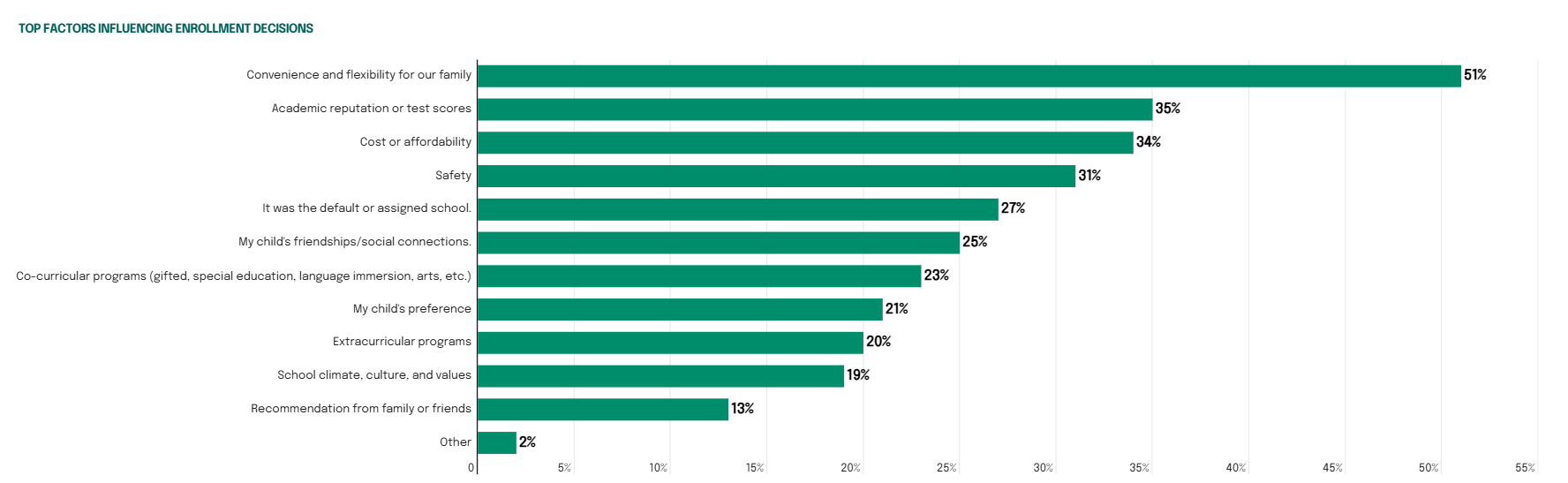
When families were asked what influenced their initial enrollment decision, the top three factors were convenience and flexibility (51%), academic reputation or test scores (35%), and cost or affordability (34%). Safety followed at 31%.
Moving the Needle on What Matters Most to Families
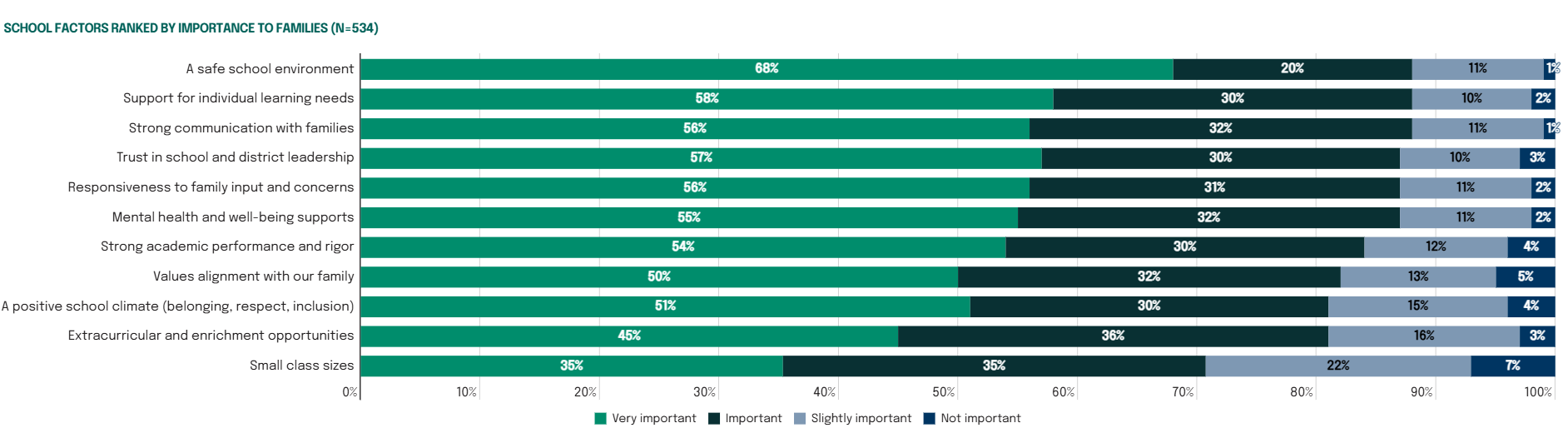
When the same families were asked what matters most in evaluating school fit, the priorities shifted. A safe school environment, support for individual learning, and strong communication with families each received “very important” or “important” ratings from 88% of respondents, with safety leading at 68% “very important.”
The pattern here is worth pausing on for district leaders: convenience and academic reputation may bring families in the door, but safety, individualized academic support, and communication are what determine whether they stay.
The Risk to Retention
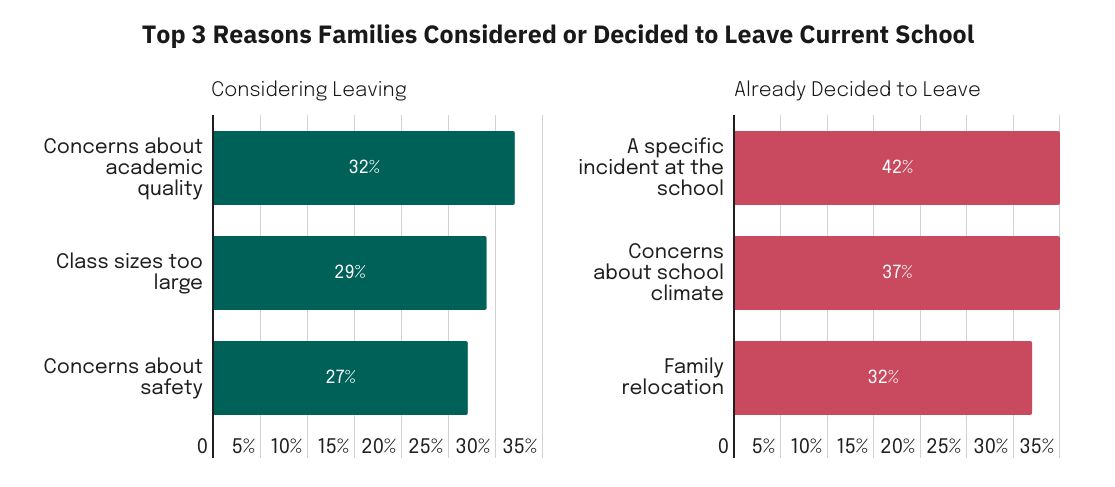
Among families exploring other schooling options, the noted the main reasons they decided to explore other schooling options were academic quality (32%), class sizes (29%), safety (27%), school climate and bullying (27%), and a specific incident at the school (23%).
For families who had already decided to leave, the drivers shifted toward situational and relational factors: a specific incident (42%), school climate (37%), and family relocation (32%). Academic doubts appear to prompt families to look; climate and relational factors appear to push them out.
Moreover, families with a student in an English Language Learner program show the highest exit risk of any subgroup measured, with only 28% saying they are “not at all” considering another school.

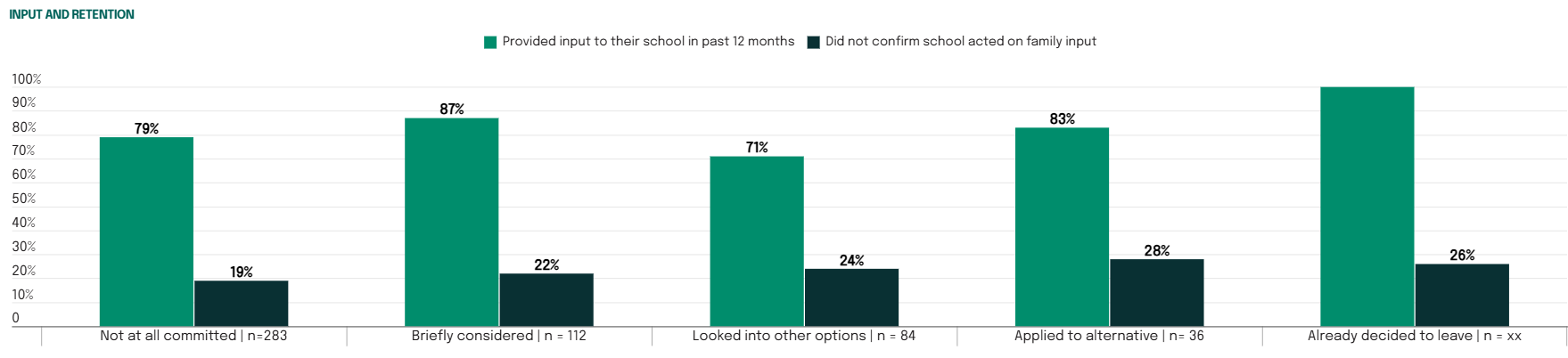
The data also surfaced an engagement paradox. In the past 12 months, 79% of families committed to their current school provided some form of input, compared with 100% of families who had already decided to leave. The share who disagreed that their school acted on that input rose from 19% among committed families to 26% among departing ones. Engagement volume alone does not build commitment. Closing the loop on family input does.
School Re-enrollment
48% of parents considered another school in the past 12 months, and 11% seriously considered leaving. The top three alternatives’ families considered were another public district (39%), homeschool (29%), and online (25%). Charter, parochial, and non-parochial private schools were named less often, at 10%, 16%, and 14% respectively.
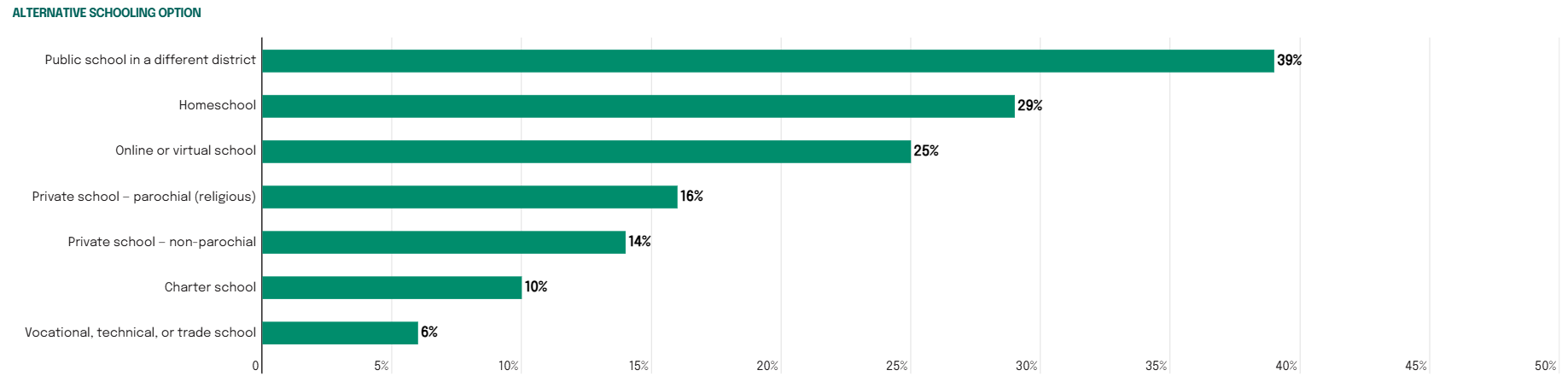
The dominant narrative around school choice frames private schools and voucher programs as the primary threat to public district enrollment. The data suggests that framing is incomplete. Most families exploring alternatives are moving to a different public school district or non-traditional public options, not out of it, reshaping retention strategies from defending against private-school competition to competing with other public and flexible learning options.
The Takeaway
For superintendents, school boards, and district leaders, the takeaway is less about responding to school choice expansion and more about the day-to-day work of aligning district investment with the priorities families rank highest. That means treating climate, communication, and responsiveness as core strategy rather than peripheral initiatives, paying focused attention to subgroups such as ELL families, and measuring whether investments are producing the outcomes families value.
Districts that close the feedback loop and let families see their input translated into action will be best positioned to sustain enrollment and community trust as the policy landscape continues to shift.