



Right now your inbox, your phone, and every billboard you drive past are full of Black Friday offers. And your Black Friday may also play out much like everyone else’s. Some new shoppers will buy, some will not, and by the following Monday your sales report will tell you how the weekend went.
That report is where most retailers stop looking, and it is the wrong place to stop. A big November is easy to celebrate and just as easy to misread. The number that really decides whether this holiday paid off comes later:
‘How many of those new shoppers come back and buy again, without a discount to pull them in?’
Marketers call that lifetime value, meaning what a single customer is worth across every purchase they make with you over time, not just the cheap first one.


Whether a first-time holiday shopper ever makes that second purchase depends far less on the deal that brought them in than on the experience they had after it. Sogolytics’ In-Store Retail CX Report 2026 found that a single bad moment during a visit raises the share of shoppers who leave with a negative outcome from 20% to 51%. During the holidays, when traffic is heavy and patience is thin, there are simply more chances for that one bad moment to happen.
A Black Friday Sale is Not a Loyalty Strategy
A discount may convince a first-time customer to give your store a try. But getting them to come back and shop again, especially when there are no discounts or special offers, depends on how much they valued the experience the first time around.
Sogolytics’ Q3 2026 Sogolytics CX Index, which surveyed 1,001 U.S. respondents, shows why. When customers were asked what drives their long-term loyalty, affordability came first at 22% and product quality second at 21%. Those feel like price points, but notice what sits dead last: personalized offers, at just 6%, down from 9% the quarter before. Customers are more likely to return when they consistently get good products at prices they consider fair. A promotional offer might bring them in once, but it takes a reliable shopping experience to keep them coming back throughout the year, not just during Black Friday.
The report also shows something surprising. Among customers who say they are loyal to a brand, 13% are very likely to switch after just one bad experience. That’s higher than the 9% of customers who don’t consider themselves loyal. Why? Loyal customers expect more from brands they trust. When a good experience turns into a bad one, they may quickly lose that trust. During the holiday rush, even one frustrating shopping experience can make a loyal customer think twice about coming back. A discount may bring customers in, but a good experience is what makes them return.
The real win on Black Friday isn’t making one more sale but giving first-time shoppers a good enough experience that they want to come back, without the discounts.
The First Purchase Sets The Tone
A customer’s first store visit, whether online or at a physical outlet, shapes how they feel about shopping with your brand again. As a retailer, you want to understand how well that first experience met their expectations:
- Did they get what they expected?
- What prompted them to make the purchase: price, brand, product quality, or service?
- Did the delivery arrive on time?
- If something went wrong, was it easy to fix or return the product?
These small moments can shape whether customers choose to shop with you again or take their business elsewhere. Event the data shows how much a single misstep costs. As per the In-Store Retail CX Report 2026, shoppers who had no issues during their visit bought everything they came for 63% of the time and were left very satisfied 50% of the time. For shoppers who ran into even one issue, both of those numbers dropped to 25%. One problem roughly cut the good outcomes in half.

Pricing clarity is one of the sharpest tests of all, as the same report found that when the final price after discounts was clear, 90% of shoppers said they would likely return. When that final price was confusing, only 50% said they would come back, a 40-point swing. During a sale season built on discounts and stacked promotions, the final number at checkout is exactly where confusion creeps in. A shopper who feels surprised by the total does not blame the coupon. They blame the store.
Returns matter just as much, especially after the holidays when exchanges and gift returns spike. A smooth return tells a nervous first-time buyer that the risk of shopping with you is low. A 40-minute return line, or a policy buried in fine print, teaches the opposite lesson at the worst possible moment.
Four Reasons Retailers Lose First-time Buyers
If you want more holiday shoppers to return, it helps to name the gaps that send them away. Four show up again and again in the data, and the same report makes clear how much they cost. What separates an unhappy customer from a happy one is rarely the product itself. It is friction. In the In-Store Retail CX Report 2026, 73% of the shoppers least likely to recommend a store had run into at least one issue during their visit, compared with 33% of those most likely to recommend it.

1. A frustrating shopping experience
Long queues and crowded stores can put shoppers off more than high prices. When asked why they planned to avoid in-store shopping this season, 52% pointed to crowds and 33% said long checkout lines. Only 26% said they could find better deals online. Product availability also matters. Shoppers are nearly twice as likely to face problems with products being out of stock, difficult to find, or unavailable in the right size (28%) than with staff (14%).
2. Unexpected charges at checkout
Shoppers are less likely to return when the final price is not clear. A product may look like a great deal on the shelf, but extra charges such as taxes, delivery fees, or platform fees at checkout can make the total higher than expected. This can leave customers feeling misled, even when the discount itself is genuine. What they remember is not the deal they found, but the unexpected amount they had to pay.
3. Chaotic return process
For many holiday shoppers, their last interaction with a store may be a product return or exchange. This is especially common in late December and January. If the process involves long queues, unclear policies, or too much effort, customers may think twice before shopping with you again. A simple return process, on the other hand, can make customers feel more comfortable buying from you in the future.
4. No followup after the purchase
The relationship with a customer shouldn’t end once the payment is made. A simple follow-up, a request for feedback, or a useful update can give first-time shoppers a reason to stay connected with your brand. But many retailers miss this opportunity.
Customers also want to know that their feedback matters. The Q3 2026 CX Index found that the share of customers who said their feedback led to a clear improvement fell from 42% to 30% in just one quarter. At the same time, the share who saw no change nearly doubled, from 17% to 29%. When customers take the time to share their experience but see no action, they have little reason to believe things will be better the next time they shop.
Measure More Than First-purchase Satisfaction
Its typical for most retail brands to collect customer feedback after a purchase, especially during busy shopping seasons. But a high satisfaction score after Black Friday doesn’t always mean customers are happy with your brand overall. The Q3 2026 CX Index shows why it’s important to look at both. This quarter, satisfaction with the most recent customer experience rose to 73%, while overall satisfaction with the brand fell to 62%. That’s an 11-point gap.
In other words, a customer may be happy with one purchase but still have doubts about the brand. One good shopping experience, even during a major sale, doesn’t automatically build long-term trust or loyalty.
-
Post-purchase satisfaction (CSAT)
How the customer felt about the product and delivery once they actually used it, not just at checkout.
-
Customer effort
How hard they had to work to get help, make a return, or get a question answered.
-
Return and exchange experience
Rated on its own, since this is where holiday buyers decide if you are safe to trust.
-
Repeat-purchase intent
A direct question about whether they plan to buy again without a discount.
-
Open feedback
The comments that explain the why behind the scores.
Tracking those signals only pays off if you close the loop, meaning you act on what you hear and let the customer know you did. The link is clear in the Q3 data: among customers who saw a clear improvement after giving feedback, 53% described themselves as very loyal, compared with only 30% of those who saw no change. Mapping where these moments sit in your own customer journey, and running a real feedback loop on top of it, is how you spot a first-time buyer drifting away before they are gone for good.
Five Ways To Turn First-time Buyers Into Repeat Customers
None of the moves below requires a bigger team or new technology. They require the same promise kept, every time, after the sale as well as during it.
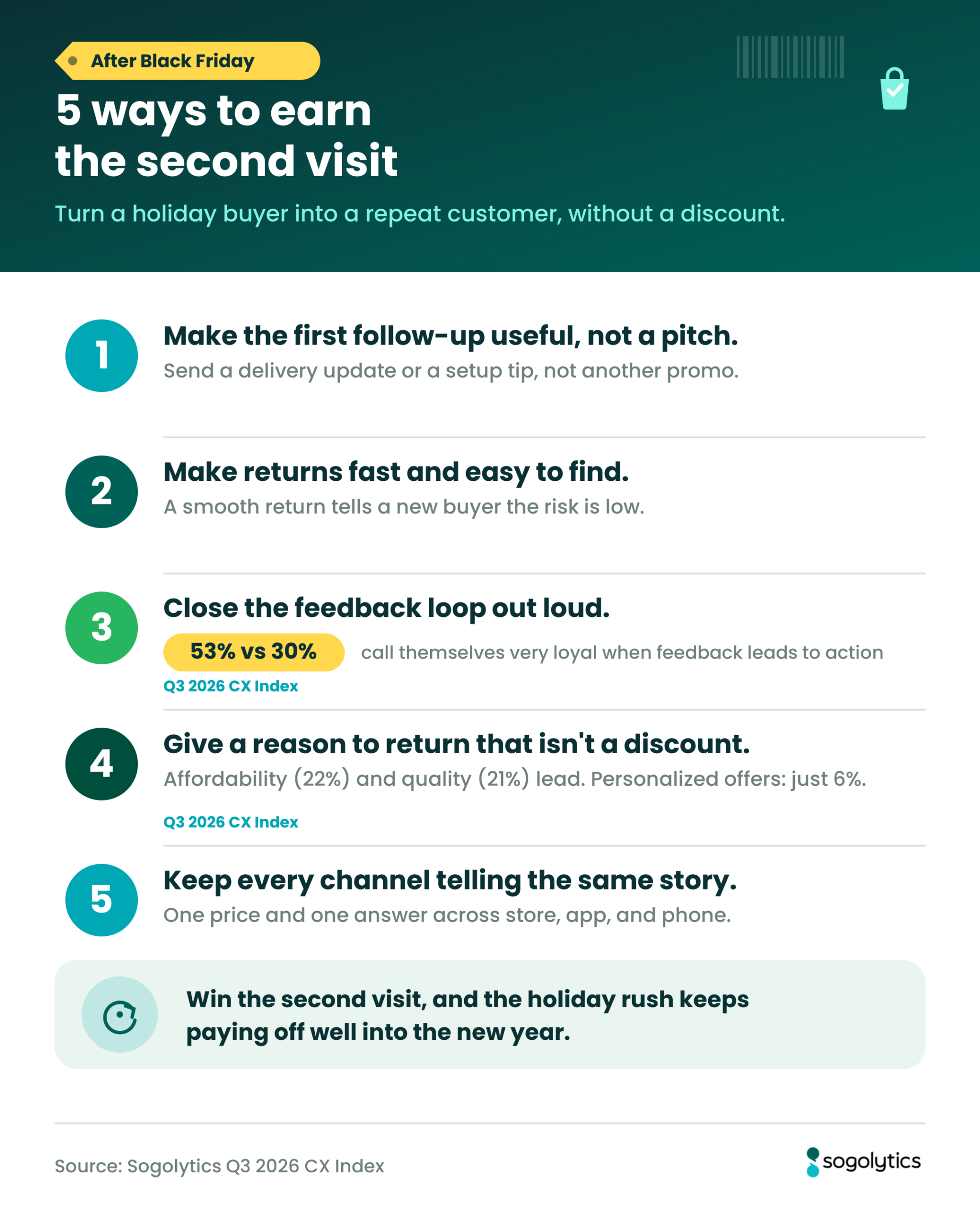
1. Make the first follow-up useful, and not promotional
A new customer’s inbox is already full of promotional emails, especially during the holiday season. Instead of sending another sales offer, share something useful. It could be a delivery update, a quick guide to using the product, or a thank-you email with contact details in case they need help. For example, a furniture store can send assembly instructions and a support number as soon as a customer’s order is shipped. This shows customers that the brand cares about their experience even after the sale.
2. Make returns simple and quick
Make sure customers can easily find your return policy and understand what they need to do. Avoid complicated steps, long queues, and unclear rules. For example, a clothing store that makes it easy to return or exchange a holiday gift gives customers one less reason to hesitate before shopping there again.
3. Show customers that their feedback matters
Collecting feedback is only useful when you do something with it. If customers complain about long checkout lines during the holiday rush, look at ways to reduce waiting times. This could mean opening more checkout counters or adding staff during busy hours. Let customers know what you’ve changed based on their feedback. When people see that a store listens and takes action, they have more reason to trust it.
4. Give customers a reason to shop with you again
Discounts can bring customers in, but they aren’t the only reason people return. Good product quality, fair prices, products that are easy to find, and helpful service all play a part in building loyalty. You can also use what you know about a customer’s past purchases to make useful suggestions, such as reminding them to refill a product or recommending a relevant replacement part. These offers are more likely to be useful than sending the same promotion to everyone. Learn more about customer loyalty programs.
5. Keep the experience consistent across channels
Customers may shop on your website, use your app, call customer support, or visit your store. They expect the same prices, offers, and information wherever they interact with your brand. If the website shows one price but the store or support team gives a different answer, customers can lose trust. Make sure all your channels share the same information so customers know what to expect.
This is the gap our team built Experience Navigator to help close. It starts with four questions about your organization, your industry, your business model, how your operation is set up, and what you are trying to achieve. From there it maps where expectations and reality drift apart in your own journey, so you can see the post-purchase friction a single satisfaction score would hide, and act on it before a holiday shopper quietly becomes a one-time shopper.
What Retailers Can Expect In 2027
The direction is already visible in the Q3 data, and a few things look likely to shape the year ahead.
Customers will keep putting the basics first. Asked what companies should prioritize over the next ten years, people named reducing costs (43%) and protecting their data (42%) well ahead of flashier options, with personalization last at 17%. The retailers who grow in 2027 will spend less on novelty and more on reliability, fair pricing, and trust.
AI will stay on probation. Only 16% of customers said AI improved their experience this quarter, the lowest reading of the year. Automation will still handle the simple, fast tasks, but a reachable human will remain a loyalty feature rather than a cost to cut, especially around returns and billing.
And loyalty measurement itself will shift. Tenure and points are losing their power to predict who stays. Expect more retail teams in 2027 to track the consistency of the experience over time, the way the Quarterly Index does, so they can catch a fading customer in February rather than discovering the loss in next year’s sales report.
The Practical Takeaway
Black Friday will bring the traffic. What you do in the weeks after decides whether any of it sticks. Pick the two moments that matter most to a first-time holiday buyer, the delivery and the return, and make them reliable before January arrives. Keep the final price honest, the follow-up useful, and the story the same across every channel. Do that, and the shopper who came in for a discount will have fewer reasons to leave and a real reason to come back.