


Food delivery apps have made ordering a meal almost effortless. A few taps, and dinner is on its way. But convenience alone does not guarantee that customers will keep coming back. A late delivery, high additional fees, or an unresolved issue can quickly change how someone feels about an app they use every week.
For food delivery platforms, this creates a challenge. They need to get every part of the experience right, from browsing restaurants and placing an order to explaining charges and handling complaints. Customers may forgive an occasional delay, but they are less likely to overlook an experience that feels confusing or unfair.
The Sogolytics CX Rankings: U.S. Food Delivery Apps 2026 examines how consumers experience five leading platforms: DoorDash, Uber Eats, Grubhub, Postmates, and Seamless. Based on a survey of 1,002 U.S. adults who had ordered through a food delivery or pickup app in the previous three months, the report looks beyond overall satisfaction to understand what drives customer loyalty.
The findings point to an important lesson: the best delivery experience is not simply about getting food to someone’s door. It is about making the entire journey easy, transparent, and dependable.
Report A survey of 1,002 U.S. delivery app users, ranking DoorDash, Uber Eats, Grubhub, Postmates, and Seamless across ordering, fees, delivery, and problem resolution. See How All Five Apps Ranked Download the report
Food Delivery is Now a Habit and Customers Have Expectations
Food delivery is no longer an occasional luxury, but has become a consistent part of many consumers’ weekly routines. According to the Sogolytics study, 59% of respondents order through a delivery app at least once a week. 30% do so a few times a week or more. Weekly use is highest among adults aged 25 to 44, with 70% to 72% ordering through a food delivery app at least once a week.
With customers relying on these platforms so often, even small problems can become frustrating when they happen repeatedly.
Consider someone who orders lunch through the same app several times a week. If the app is easy to navigate, remembers their preferences, and makes checkout simple, there is little reason to switch. But if they repeatedly encounter unclear charges or are dissatisfied with the resolution of a missing items, they may start looking elsewhere.
The most common reason people chose an app for their latest order was familiarity. In fact, 27% said they chose the app they usually use. Price and faster or more reliable delivery followed at 24% each, while promotions and discounts influenced 21%.
This suggests that platforms have an opportunity to build loyalty by making the everyday experience worth repeating, rather than depending only on discounts to bring customers back.
DoorDash Leads in App Experience, but Every Platform Has Its Strengths
An easy ordering process can make a real difference in how customers feel about a delivery app.
In the overall Application Experience ranking, DoorDash takes the top position with a score of 78.1%, followed by Uber Eats at 76.3%. Grubhub scores 72.4%, Seamless 66.3%, and Postmates 64.6%.
DoorDash’s advantage comes largely from ease of use. 85% of its users were satisfied with how easy it was to use the app or website, compared with 81% of Uber Eats users.
The difference may seem small, but ease of ordering has a strong relationship with customer recommendation. Across the study, respondents who strongly agreed that an app made ordering easy had an NPS of +75. Those who simply agreed had an NPS of +24.
That is a 51-point difference!
For app teams, this is a useful reminder that an experience that customers describe as good may not be enough to turn them into brand advocates. Improving user experience like removing unnecessary steps, making restaurant information easy to find, and keeping checkout straightforward can help move the experience from “acceptable” to “genuinely convenient.”
Uber Eats ranks first in Delivery and Order Quality Experience, with stronger results for order accuracy, driver adherence to delivery instructions, and food quality on arrival.
The takeaway is that customer experience has several moving parts. So a food delivery platform can perform well in one area while leaving room for improvement in another, leading to a possible leaky funnel.
Customers Want to Understand What They Are Paying For
Delivery fees are one of the most sensitive parts of the ordering experience.
Customers may be willing to pay extra for convenience, but they want to understand what those charges cover and whether the final amount feels fair.
The Sogolytics study found that 78% of respondents could see the full cost of their order before checkout. However, only 65% agreed that additional fees were reasonable.
Showing customers the final price is important, but transparency does not automatically create acceptance.
Imagine a customer placing an order for a meal advertised at $20. By the time service fees, delivery charges, and other costs are added, the final amount is considerably higher. Even when those charges are visible, the customer may question whether the order is worth the expense.
Uber Eats ranks first in Pricing and Cost Transparency at 72.6%, closely followed by DoorDash at 72.2%. Uber Eats also performed better on whether customers felt the total cost was worth paying.
For delivery platforms, this means pricing should be treated as part of the customer experience, not just a checkout function.
Clear fee descriptions, upfront cost breakdowns, understandable tipping options, and promotions that deliver real value can help customers feel more confident about their purchases.
What Happens After a Problem Can Make or Break Loyalty
Even well-designed apps cannot prevent every problem. Restaurants may miss an item, orders may arrive late, or food may be delivered to the wrong address.
What matters next is how the issue is resolved.
In the Sogolytics study, 43% of respondents said they had experienced an issue with their app or order. The way the platform handled that issue had a clear relationship with satisfaction.
Customers who received a full refund reported a CSAT score of 78. Those who received a partial refund scored 64, while a credit or coupon earned 61. When no resolution was offered, satisfaction fell to just 12.
These differences show why a generic apology or a coupon for a future order may not always be enough. Customers want a solution that addresses the problem they experienced.
For example, if a customer receives an incomplete grocery order, a discount on their next purchase does not replace the missing items. A refund or timely replacement is more likely to restore confidence.
The rankings offer another interesting insight. Grubhub and Postmates tied for the highest satisfaction with problem resolution, with CSAT scores of 69. Postmates also ranked first in ease of resolving a problem, with a Customer Effort Score of 5.93 out of 7.
This is particularly important because customers remember how a company treats them when something goes wrong. A smooth recovery can prevent one poor experience from becoming a reason to leave.
Memberships Work When Customers See Real Value
Paid memberships are another way delivery platforms encourage repeat orders. Services such as DashPass, Uber One, and Grubhub+ offer benefits such as reduced delivery costs, discounts, and additional promotions. The study found that 59% of respondents paid for a membership with the app they used. Among these members, 86% felt their membership was worth the cost, at least to some extent.
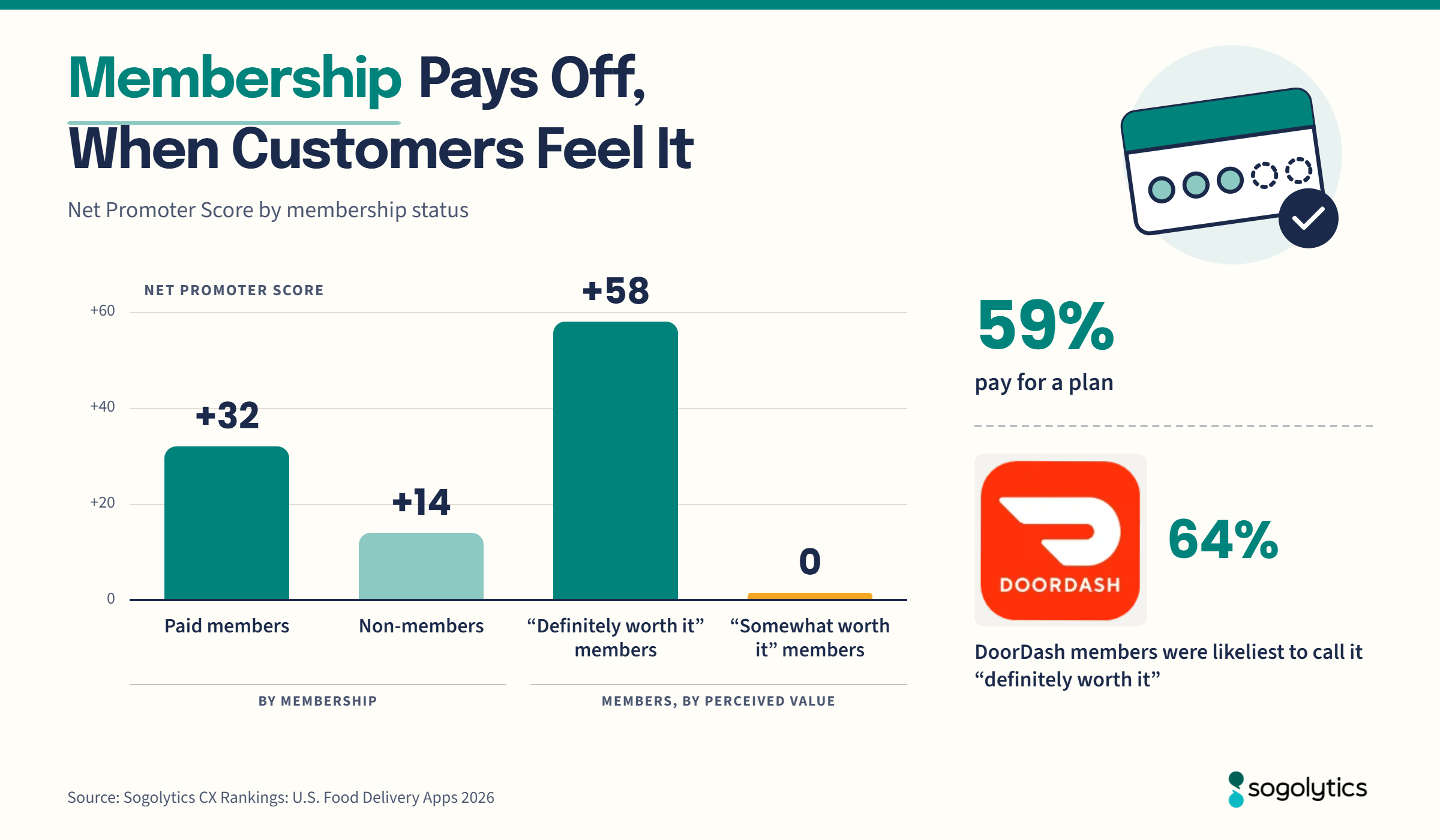
But there is an important difference between customers who think a membership is definitely worth it and those who are only somewhat convinced. Members who said their subscription was definitely worth it had an NPS of +58. Those who felt it was somewhat worth it had an NPS of zero. Non-members, meanwhile, had an NPS of +14. This suggests that simply getting customers to subscribe is not enough. They need to see consistent value in return.
For example, a frequent customer may appreciate lower delivery fees and exclusive discounts. Whereas someone who orders only once or twice a month may struggle to justify the same subscription cost.
Platforms should therefore look beyond membership sign-ups and understand whether customers are using the benefits, saving money, and finding the service worthwhile.
Build Loyalty by Improving the Moments Customers Remember
The Sogolytics CX Rankings reveal that customer loyalty is shaped by several connected experiences. Easy ordering, transparent pricing, reliable delivery, and effective problem resolution all play a role.
However, not every improvement has the same impact. The study found that ease of order placement had the strongest correlation with likelihood to recommend, at 0.67. Problem handling satisfaction was the most important driver within the app experience factors examined.
Postmates also offers an interesting example. It ranked first in NPS with a score of +35, ahead of Uber Eats (+26), DoorDash (+25), Grubhub (+18), and Seamless (+3). Its results remained relatively strong even among customers who had experienced an order problem. Interestingly, Postmates and Uber Eats share the same app infrastructure, yet their customer loyalty results after an issue were very different. Uber Eats’ NPS dropped from +45 among customers without an issue to +1 among those who experienced one. This shows that technology alone does not determine the quality of an experience. The policies, support processes, and decisions behind that technology matter just as much.
For food delivery leaders, the next step is to understand where customers struggle and which improvements will make the greatest difference. That means looking beyond overall satisfaction scores. Teams need to examine feedback across the ordering journey, identify recurring problems, compare customer expectations with actual experiences, and measure whether changes are improving satisfaction and loyalty.
Measure the Moments That Keep Your Customers See how teams use Sogolytics to track ordering, fees, delivery, and problem resolution, then act on what truly moves loyalty. Request a Demo