



For most of its history, customer feedback has worked like a rear-view mirror. An institution runs a survey, waits for the results, discovers that something went wrong weeks ago, and launches a project to fix it. By then the affected customers have already formed their judgment, and some have already left. In a real-time, digital financial relationship, that lag is increasingly a liability.
This article, the conclusion of the series, argues that Fintech customer experience is moving from reactive feedback, through continuous listening, toward predictive experience management that anticipates friction before it reaches the customer. It lays out the three-stage maturity path, the operating model that makes prediction possible, and why the separate initiatives this series has examined are the leading indicators of a single system.


Where Reactive Feedback Falls Short
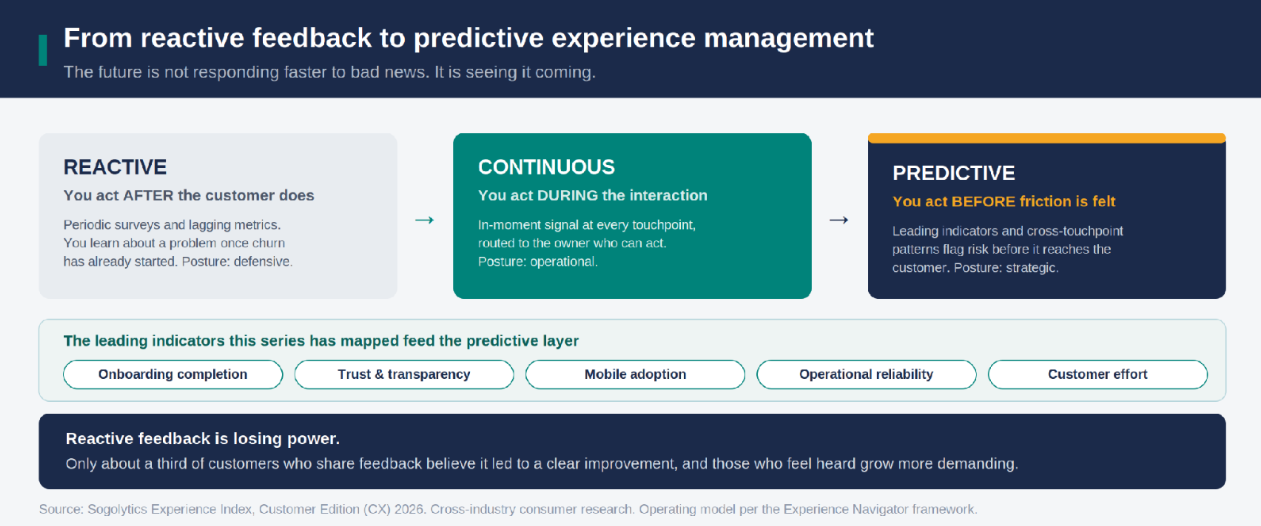
Two findings make the limits of the reactive model concrete. The first is that customers increasingly doubt feedback leads anywhere: only about a third of those who share it believe it produced a clear improvement.
A second finding in the same research complicates that picture. As more customers feel heard, they grow more demanding, and those who have seen a company act on their feedback become more willing to switch when the next experience disappoints.
Proactive, action-oriented experience management exists because reactive feedback does two things at once. It responds slowly, and it raises expectations it then struggles to meet.
Reactive feedback also has a blind spot. The customers who matter most to retain rarely show up in it at all. As this series discussed, high-effort customers seldom complain. They tend to disengage and leave rather than raise the issue.
A survey captures the customers willing to tell you they are unhappy, not the larger group who have decided to go. An institution that waits for feedback is, by design, blind to its most dangerous churn.
Continuous Listening is the Necessary Middle Step
The first move beyond reactive feedback is to make listening continuous rather than periodic. Instead of a quarterly survey, signal is captured in the moment at each touchpoint, so friction is visible while it is still fixable and can be routed to the team that can act.
This is the experience operations posture examined earlier in the series: the shift from measuring endpoints to running experience as a discipline, supported by a coherent framework for customer experience management.
Continuous listening is a large advance over reactive feedback, but it remains fundamentally responsive. It registers friction at the moment it occurs, which is later than an institution would want.
The Case for Predictive Experience Management
Predictive experience management adds the layer that changes the economics. It uses leading indicators and patterns across touchpoints to flag risk before the customer feels it.
The raw material for prediction is exactly what this series has mapped: onboarding completion and effort, mobile adoption and reliability signals, trust and transparency measures, and resolution and effort scores. Each is a leading indicator, a movement that precedes churn rather than confirming it after the fact.
The effort and reliability signals that predict loyalty are the clearest example. Watched together and continuously, they reveal patterns that let an institution intervene while the customer is still winnable.
The practical form is familiar in outline. A customer whose effort scores are climbing across several interactions, whose logins are becoming less frequent, and who has just experienced a failed transaction is a customer a predictive model can flag for proactive outreach before they scale back the relationship.
The reactive model would have learned about this customer only from an exit survey, if at all. The predictive model acts while there is still something to act on.
The Three Stages from Reactive to Predictive
Most institutions can locate themselves on a simple maturity path, and knowing where you are is the first step to advancing.
The stages are cumulative. Prediction depends on continuous listening; it becomes possible only once enough signal is flowing to reveal patterns. An institution cannot skip to prediction without first building the continuous foundation beneath it.
The Operating Model that Makes this Possible
Predictive experience management runs on an operating model. Analytics tools support it, but the model is what makes prediction usable.
It requires a complete map of where the relationship happens, across digital, physical, process, and human touchpoints, so that signal is captured everywhere rather than only where it is convenient. It requires that each touchpoint be tied to the metric that exposes its failure and the feedback that measures it, so the data feeding prediction is structured rather than noise.
And it requires cross-functional governance to act on what the model finds, because a prediction no one owns changes nothing. Journey-level analytics turn that structure into visible patterns.
This is what the Experience Navigator framework provides. It begins with the institution’s industry, business model, operational scope, and objectives, then maps the journey to the touchpoints, pain points, metrics, and projects that make experience measurable and, ultimately, predictable.
The human dimension does not disappear at the predictive stage. It becomes more important. Customers remain wary of automation in exactly the moments prediction is most tempting to automate, the high-stakes financial ones, and they still prefer a person for the decisions that carry weight.
Done well, prediction removes effort and pre-empts problems while reserving human judgment for the moments customers want it. Prediction that feels intrusive, or that replaces reassurance with automation, will erode the trust it was meant to protect.
The Maturity Path: How Reactive, Continuous, and Predictive Differ
| Dimension | Reactive | Continuous | Predictive |
|---|---|---|---|
| When you learn | After the customer acts, once churn shows up | While the interaction is happening | Before the friction reaches the customer |
| Signal used | Periodic surveys, lagging metrics | In-moment feedback at each touchpoint | Leading indicators and cross-touchpoint patterns |
| Typical action | Post-mortem and recovery | Real-time routing and fix | Pre-emptive, proactive intervention |
| What it catches | Customers who complain | Customers experiencing friction now | Silent, high-effort customers before they leave |
| Business posture | Defensive | Operational | Strategic |
The stages are cumulative; predictive capability rests on the continuous foundation beneath it. Structure per the Experience Navigator framework.
What this Means for the Executive Team
For Fintech teams managing CX, the shift to predictive experience management reframes several separate initiatives as one.
The onboarding fixes, the trust and transparency work, the mobile adoption effort, the reliability investment, and the campaign against customer effort work as leading indicators of a single system rather than as independent projects competing for budget. Each one improves an outcome now and feeds the predictive capability that protects outcomes later.
Seen this way, customer experience in financial services becomes an operating capability that compounds. Every touchpoint instrumented today is a signal available for prediction tomorrow, so the improvements build on one another instead of standing alone.
Where To Begin
The scale of the shift can make it sound like a multi-year transformation to be deferred, which is the wrong conclusion. The path is incremental, and each step pays for itself.
Begin by instrumenting the two or three journeys that carry the most value and the most risk, usually onboarding, money movement, and issue resolution, with in-moment effort and trust measures. That alone moves an institution from reactive to continuous on the moments that matter most.
As signal accumulates, add the cross-touchpoint view that lets patterns surface, and only then layer prediction on top. Most institutions get stuck by treating prediction as a product to buy instead of a capability to build over time. A workable approach starts small, proves the value on a few high-stakes journeys, and expands coverage as the operating model earns its keep.
Where this Leaves the Industry
The next competitive advantage for Fintech brands will come from anticipating friction before it reaches the customer. Moving from reactive feedback to predictive experience management happens in stages: continuous listening comes first, built on a complete map of the customer journey, with the governance in place to act on what the signal reveals. A structured framework gives that progression a shape and turns the scattered work of surveys and dashboards into a coherent operating model.
The reactive approach tells an institution what already went wrong, while a predictive CX one gives it time to intervene before a customer feels the friction. For the institutions building that capability now, the payoff is concrete: fewer customers leaving without warning, earlier intervention on the accounts worth keeping, and a clearer view of which journeys to fix first.
Practical Takeaways
- Recognize the limits of reactive feedback. It is slow, it raises expectations it cannot meet, and it never hears from your most dangerous churn.
- Build continuous listening first. In-moment signal at every touchpoint is the foundation prediction requires; you cannot skip to predictive.
- Treat your existing CX metrics as leading indicators. Onboarding effort, adoption, reliability, trust, and effort scores predict churn when watched together.
- Instrument the whole journey, across digital, physical, process, and human touchpoints, so prediction has structured signal rather than gaps.
- Keep humans in the high-stakes moments. Use prediction to remove effort and pre-empt problems, not to automate away the reassurance customers still want.
It is the practice of using leading indicators and patterns across touchpoints to anticipate customer friction before it happens, rather than learning about it afterward. Instead of reacting to complaints or waiting for survey results, an institution watches signals such as rising effort, declining login frequency, and recent transaction failures to flag at-risk customers and intervene proactively. It is the most advanced stage of a maturity path that runs from reactive feedback, through continuous in-moment listening to prediction.
Traditional feedback is reactive and backward-looking. It tells you what went wrong after customers have already experienced it, often only from the minority willing to respond. Predictive CX is forward-looking. It combines continuous signal from every touchpoint to identify risk before the customer feels it, including the high-effort customers who never complain. The difference comes down to timing and coverage. Reactive feedback reaches the customers who complain, and only after the fact. Prediction can flag at-risk customers who never say anything, in time to act.
The strongest are the ones this series has mapped: rising customer effort, weak onboarding completion and activation, declining mobile adoption and engagement, reliability failures on money-movement paths, and falling trust or transparency scores. Individually each is informative; combined and tracked continuously, they form patterns that precede attrition. A customer showing several of these signals at once, climbing effort plus falling engagement plus a recent failed transaction, is at far higher risk than any single metric would suggest.
Not realistically. Prediction depends on a continuous flow of structured signal from across the journey, which is the continuous-listening stage. An institution still relying on periodic surveys does not yet have the data density or the touchpoint coverage that prediction requires. The practical path is to build continuous, in-moment listening first, instrument the full journey, and establish the governance to act, then layer prediction on top once the signal is rich enough to reveal reliable patterns.
By using prediction to remove effort and pre-empt problems, while reserving human judgment for the high-stakes moments customers still want handled personally. Customers generally prefer a person for weighty financial decisions and emotionally charged situations, even as they welcome automation for speed on routine tasks. The better approach lets prediction work in the background to prevent friction and brings a human forward at the moments where reassurance matters more than speed.
Experience Navigator provides the structured foundation prediction requires. It maps the journey from the institution’s industry, business model, operational scope, and objectives down to the specific touchpoints, pain points, metrics, and feedback projects across digital, physical, process, and human channels. That structure ensures signal is captured everywhere and tied to the right metric, which is precisely the organized, comprehensive data a predictive capability needs. It turns a scattered set of surveys into a coherent operating model that can grow from continuous listening into prediction.